
About This Worksheet
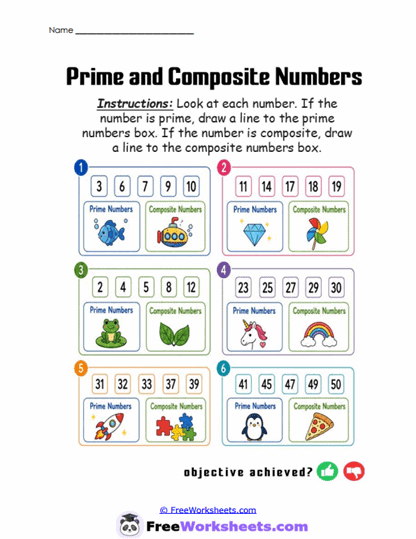
Factor Sort Cards is a fourth grade prime-and-composite activity that uses themed sorting boxes to make number classification more engaging. Each section gives five numbers and two labeled targets for Prime Numbers and Composite Numbers. Students determine where each number belongs and draw a line to the correct category. The changing pictures, such as fish, diamonds, leaves, rainbows, rockets, puzzles, penguins, and pizza, add variety while the mathematical goal stays the same.
Curriculum and Grade Alignment
This worksheet is intended for fourth grade learners who are practicing number classification using factors. The main goal is to help students quickly decide whether a number has exactly two factors or more than two factors. Before beginning, your child should be comfortable finding simple factor pairs and recognizing common multiples. The next step is counting primes and composites in larger number ranges. This activity supports factors, prime numbers, composite numbers, and divisibility reasoning.
Student Tasks
Students will classify thirty numbers across six themed groups. The values include examples such as 3, 6, 7, 9, 10, 11, 14, 17, 18, 19, 2, 4, 5, 8, 12, 23, 25, 27, 29, 30, 31, 32, 33, 37, 39, 41, 45, 47, 49, and 50. Students connect each value to its correct prime or composite category. This gives students practice with both easy and less obvious examples.
Common Challenges and Misconceptions
Some students may classify 49 as prime because it is odd and does not end in 5. Others may miss that 25 is composite because 5 × 5 = 25. A child may also think 2 is composite because it is even. Encourage your child to remember that 2 is the only even prime number. For harder values, checking simple factor pairs can quickly prove whether a number is composite.
Implementation Guidance
Teachers can use this worksheet after students have worked with direct prime-and-composite identification. It works well as a fluency page because there are thirty numbers to classify. Parents can have the child circle obvious composites first, then test the remaining values. This can make the page feel less overwhelming and encourages efficient use of divisibility rules.
Details and Features
This worksheet includes six themed sorting groups with five numbers in each. Each group has a Prime Numbers box and a Composite Numbers box. The numbers range from 2 through 50 and include several useful trickier examples. The printable supports factor recognition, prime-composite fluency, divisibility, and classification.