
About This Worksheet
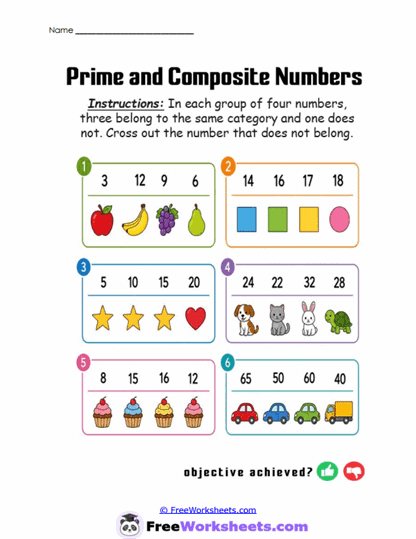
Factor Pattern Hunt is a fourth grade prime-and-composite activity that asks students to examine number groups and find the one value that does not share the same classification as the others. Each set contains four numbers with a hidden pattern based on factors. Students cross out the value that does not belong. The repeated format helps children become faster at recognizing common composites while still checking less obvious numbers.
Curriculum and Grade Alignment
This worksheet is made for fourth grade learners who are developing fluency with prime and composite classification. The main goal is to help students use factor knowledge to spot number patterns. Before using this page, your child should know how to find factor pairs and understand the definitions of prime and composite. The next step is using divisibility rules to classify larger values more efficiently. This activity supports factors, divisibility, number classification, and pattern recognition.
Student Tasks
Students will work through six groups of four numbers. The values include sets such as 3, 12, 9, 6; 14, 16, 17, 18; 5, 10, 15, 20; 24, 22, 32, 28; 8, 15, 16, 12; and 65, 50, 60, 40. Students identify the number that does not share the same prime-or-composite status as the rest. This gives them practice with both smaller and larger values.
Common Challenges and Misconceptions
Some students may classify numbers only by whether they are odd or even. Others may mistake values such as 15 or 25 as prime because they have fewer obvious factor pairs than some even numbers. A child may also forget that numbers greater than 2 that are even are always composite. Encourage your child to use quick divisibility checks for 2, 3, and 5, then test other factor pairs when needed. This makes the process more efficient.
Implementation Guidance
Teachers can use this worksheet as follow-up practice after students understand factors and divisibility. It works well as a warm-up or short independent review. Parents can ask the child to explain why the chosen number is different rather than simply crossing it out. That explanation can reveal whether the child truly understands the classification.
Details and Features
This worksheet includes six illustrated groups of four numbers. Students cross out the one number that does not belong based on prime-or-composite classification. The sets include a range of values from single digits into the sixties. The printable supports factors, divisibility, number patterns, and prime-and-composite fluency.