
About This Worksheet
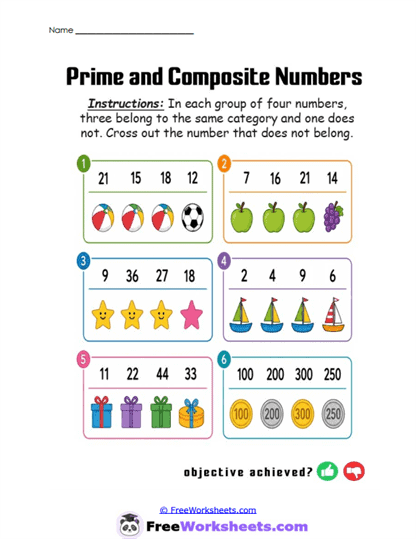
Category Outlier is a fourth grade number-classification activity that gives students more practice finding the one value that does not belong. Each group contains four numbers, and students identify the number whose factor structure differs from the other three. Some sets are mostly composite, while others are mostly prime. This keeps students from relying on a single shortcut and encourages them to actually think about the factors of each number.
Curriculum and Grade Alignment
This worksheet is intended for fourth grade learners who are strengthening recognition of prime and composite numbers. The main goal is to help students classify numbers by factor count and identify the outlier in each set. Before beginning, your child should understand what makes a number prime and what makes a number composite. The next step is sorting larger sets and using divisibility rules to work more efficiently. This activity supports factor reasoning, number classification, and divisibility awareness.
Student Tasks
Students will complete six groups of four numbers. The sets include values such as 21, 15, 18, 12, 7, 16, 21, 14, 9, 36, 27, 18, 2, 4, 9, 6, 11, 22, 44, 33, and larger multiples such as 100, 200, 250, and 300. Students cross out the one number in each group that does not fit the others. This broad range helps them apply prime-and-composite thinking beyond only small facts.
Common Challenges and Misconceptions
Some students may assume that any large number is composite without checking. Others may struggle with values like 11 or 7 because they are odd but must still be tested for factors. A child may also incorrectly classify a square number such as 9 as prime. Encourage your child to check whether any whole number besides 1 and itself divides evenly into the value. If so, it is composite.
Implementation Guidance
Teachers can use this worksheet after students have practiced factor pairs. It works well as an independent classification check or as partner work. Parents can have the child circle obvious composites first, such as multiples of 2, 5, or 10, then check the remaining values more carefully. This builds efficient number sense without replacing the factor definition.
Details and Features
This worksheet includes six colorful number groups with four values each. Students identify the one prime-or-composite outlier in each set. The values include both small numbers and larger multiples. The printable supports prime numbers, composite numbers, factors, divisibility, and classification.