
About This Worksheet
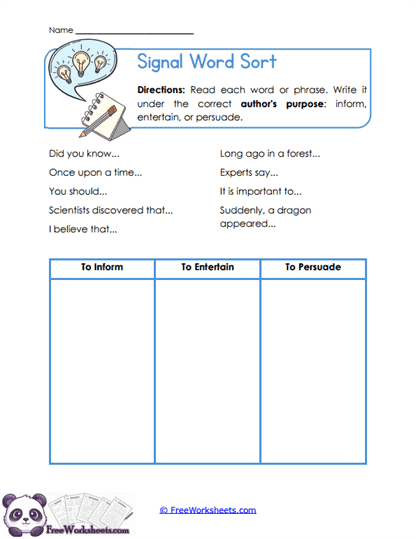
This worksheet helps students recognize clue words and phrases that signal an author’s purpose. These are the little hints in a text that tell us if the author wants to inform, entertain, or persuade.
By sorting these phrases, students begin to notice patterns. Over time, they start spotting these clues naturally when they read.
It’s a simple activity with long-term benefits.
Curriculum and Grade Alignment
This worksheet supports Grade 2 author’s purpose and language skills and aligns with CCSS RI.2.6.
Student Tasks
Students sort words and phrases into categories based on whether they signal informing, entertaining, or persuading.
Common Challenges and Misconceptions
Students may focus on individual words without thinking about the full meaning of the phrase.
A helpful prompt is: “What is the speaker trying to do with these words?”
Implementation Guidance
Discuss each phrase as a group before sorting to build understanding.
Details and Features
This worksheet focuses on pattern recognition, which is a key skill in early reading development. By grouping phrases based on purpose, students begin to see how language connects to meaning. The activity is interactive and flexible, making it easy to use in small groups or whole-class instruction. It also builds vocabulary and comprehension at the same time. Over time, students become more confident in identifying purpose because they recognize these familiar signals.
Curriculum Overlap
Signal words support many literacy skills.
- Builds vocabulary
- Strengthens comprehension
- Supports writing awareness
- Encourages critical thinking