
About This Worksheet
This worksheet is a great starting point for helping young readers understand what text features are and why they matter. At this age, students often see headings, captions, and diagrams-but they don’t always know what those parts actually do.
Here, students are matching each feature to its purpose, which helps them begin to see nonfiction texts as organized and helpful-not confusing. It’s a simple task on the surface, but it builds an important foundation.
Think of this as helping students learn the “tools” authors use to guide readers.
Curriculum and Grade Alignment
This activity supports Grade 2 informational text skills and aligns with CCSS RI.2.5.
Student Tasks
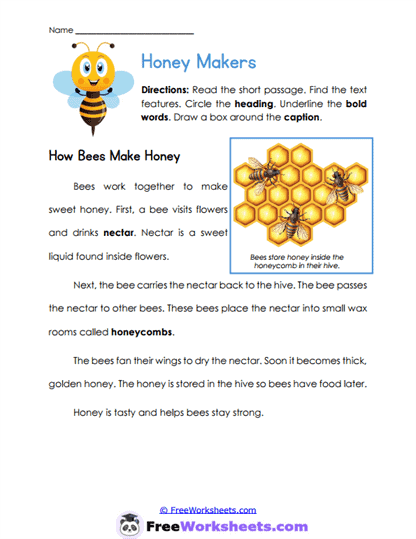
Students will match text features (heading, caption, glossary, diagram) to their correct purposes and answer a follow-up question.
Common Challenges and Misconceptions
Students often mix up captions and diagrams, since both relate to pictures.
A helpful reminder is: “A caption talks about the picture. A diagram labels parts of something.”
Implementation Guidance
Encourage students to say each match out loud and explain their thinking.
Details and Features
This worksheet focuses on four high-frequency text features that students will see across many nonfiction texts. The matching format keeps the task clear and manageable while still requiring thinking. The follow-up question adds an extra layer by asking students to apply what they learned. The structure supports both recognition and understanding, which is exactly what early readers need. It also builds confidence by giving students a clear “right or wrong” structure before moving into more open-ended tasks later.
Curriculum Overlap
Understanding text features supports broader reading skills.
- Helps with nonfiction comprehension
- Builds vocabulary awareness
- Supports research skills
- Strengthens reading confidence