
About This Worksheet
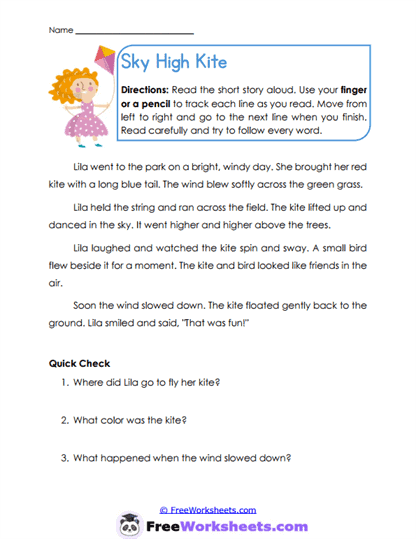
This worksheet is all about helping young readers build confidence as they read a full story from beginning to end. At this stage, students are still developing fluency, so giving them a simple, engaging story-like flying a kite-helps them focus on reading smoothly without feeling overwhelmed.
What makes this activity especially valuable is the built-in support for tracking print. When students use their finger or a pencil to follow along, they are strengthening one-to-one matching, which is a foundational reading skill. This helps prevent skipping words or losing their place.
The story itself also gives students a gentle introduction to sequencing and visualization. They can picture what’s happening while also answering simple comprehension questions to check their understanding.
Curriculum and Grade Alignment
This worksheet supports Grade 2 fluency and comprehension skills, including tracking print, answering questions, and understanding story details. It aligns with CCSS RF.2.4 and RL.2.1.
Student Tasks
Students will read the story aloud, track each line with their finger or pencil, and answer basic comprehension questions.
Common Challenges and Misconceptions
Some students may rush through the reading and skip words. Others may focus so much on decoding that they miss the meaning.
A helpful reminder is: “Slow down and make your reading sound like talking.”
Implementation Guidance
Encourage repeated readings. The first read builds familiarity, and the second read improves smoothness and confidence.
Details and Features
This worksheet includes a short, engaging narrative that is intentionally written with clear sentence structure and accessible vocabulary for Grade 2 readers. The directions guide students to actively track their reading, which strengthens accuracy and focus. The comprehension questions are straightforward and directly tied to the text, helping students practice locating answers. The story also includes descriptive language that supports visualization, allowing students to better connect with what they are reading. Overall, the structure supports both fluency development and comprehension in a balanced way.
Curriculum Overlap
Fluency connects directly to comprehension and writing development.
- Builds reading confidence
- Strengthens attention to detail
- Supports storytelling skills
- Improves oral reading