
About This Worksheet
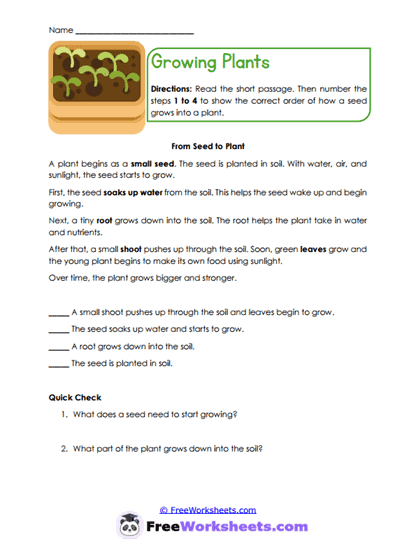
This worksheet helps students understand how informational texts often explain a process in steps, which is a key structure they will see again and again in both reading and science. Instead of just reading about plants, students are learning how to follow a sequence and make sense of how one step leads to the next.
What’s especially helpful here is that students are not just answering questions-they are actively organizing the information. By putting the steps in order, they are showing that they truly understand how a plant grows, not just remembering random facts.
This kind of thinking builds a strong foundation for both reading comprehension and scientific understanding.
Curriculum and Grade Alignment
This worksheet supports Grade 2 students in understanding sequence and informational text structure. It aligns with CCSS RI.2.3 and RI.2.1.
Student Tasks
Students will read the passage, reorder the steps of how a plant grows, and answer follow-up questions about the process.
Common Challenges and Misconceptions
Students may mix up the order of steps or focus on what seems most important rather than what comes first. Some may also skip back into the text without carefully checking each part.
A helpful prompt is: “What happens first? What comes next?”
Implementation Guidance
Teachers can model numbering the first step together. Parents can ask: “Can you explain the steps in your own words?”
Details and Features
This worksheet is built around a clear process-based informational text that teaches students how to follow and organize sequential information. The step-ordering activity is especially valuable because it requires students to think about the structure of the text, not just the content. Each step is written in a way that reflects cause-and-effect relationships, helping students understand how one stage leads to the next. The passage also introduces science vocabulary in a natural, supportive way, reinforcing both reading and content knowledge. The included comprehension questions extend understanding by asking students to reflect on key parts of the process, encouraging deeper thinking beyond simple recall.
Curriculum Overlap
Understanding sequences supports learning across subjects, especially science and writing.
- Builds sequencing skills
- Supports science concepts
- Strengthens comprehension
- Helps with procedural writing