
About This Worksheet
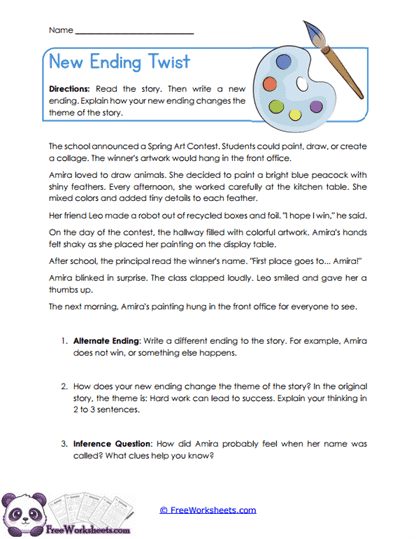
This worksheet takes students into a more creative and flexible type of thinking by asking them to change the ending of a story and reflect on how that change affects the theme. This is a powerful way to deepen understanding, because students are no longer just identifying meaning-they are actively shaping it.
At this level, many students are just beginning to understand that the theme of a story is connected to what happens. When they change the ending, they begin to see that the lesson can change too. That realization is a major step in reading development.
This activity also gives students a chance to connect creativity with comprehension. They are not just imagining a new ending for fun-they are thinking carefully about how that new ending changes the message.
Curriculum and Grade Alignment
This worksheet supports Grade 2 students in understanding how theme is developed and how it can change based on story events. It aligns with Common Core RL.2.2 and RL.2.1. It also connects to TEKS standards for comprehension, inference, and writing.
Student Tasks
Students read the original story and then write an alternate ending. After that, they explain how their new ending changes the theme of the story. They also answer an inference question about how the character likely felt at a key moment.
Common Challenges and Misconceptions
Students may create a new ending that does not connect logically to the story. Others may struggle to explain how the theme changes. Some may describe the new ending without addressing the lesson at all.
It helps to guide them with questions like:
“What lesson does the original story teach?”
“If your ending changes, what new lesson does it teach?”
Implementation Guidance
Teachers can model one alternate ending as a class and discuss how it changes the message. This makes the connection between events and theme much clearer.
Parents can support by asking:
“If the story ended differently, what would it teach instead?”
Details and Features
- Creative writing component
- Theme analysis
- Inference question included
- Encourages flexible thinking
Curriculum Overlap
This kind of activity strengthens both reading and writing at the same time. Students learn that meaning is not fixed-it depends on how a story unfolds. This builds strong analytical and creative thinking skills.
- Encourages creative writing
- Deepens understanding of theme
- Builds analytical thinking
- Strengthens comprehension