
About This Worksheet
This is such a strong early inference activity because it helps students move beyond what is said and start thinking about what is felt. At this level, many students can tell you what happened in a story, but figuring out how a character feels-and why-is a deeper level of understanding.
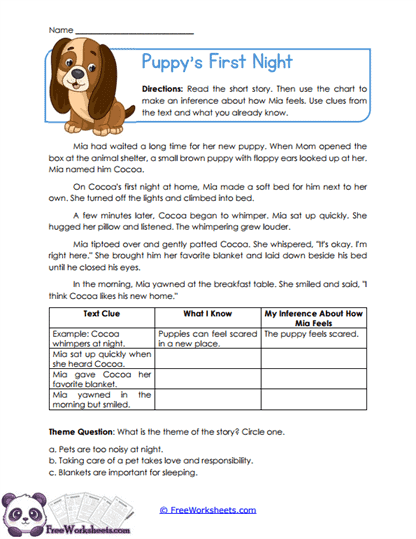
In this story, Mia cares for her new puppy, and students are asked to combine what they read with what they already know. That’s really the heart of inference:
“What clues do I see, and what do they tell me?”
It’s a gentle but powerful way to build emotional understanding and reading comprehension at the same time.
Curriculum and Grade Alignment
This worksheet supports Grade 2 students in making inferences and identifying theme. It aligns with Common Core RL.2.1 and RL.2.2 and connects to TEKS standards for comprehension and character understanding.
Student Tasks
Students read the story and use a chart to track:
- What the text says
- What they already know
- What they can infer about how the character feels
They also choose a theme, which helps them start thinking about the lesson behind the story.
Common Challenges and Misconceptions
Students often think the answer has to be directly in the text. They may say, “It doesn’t say that!” That’s where we remind them:
“You’re using clues + your thinking.”
Some may also confuse feelings with actions. Modeling this difference really helps.
Implementation Guidance
Teachers can pause and ask:
“What does this tell us, even if it doesn’t say it exactly?”
Parents can support by asking:
“How do you think the puppy felt? What makes you think that?”
Details and Features
- Inference chart scaffold
- Emotional understanding focus
- Theme question included
Curriculum Overlap
Inference supports comprehension across all reading. It also builds empathy and critical thinking.
- Builds emotional awareness
- Strengthens comprehension
- Supports discussion
- Encourages deeper thinking