
About This Worksheet
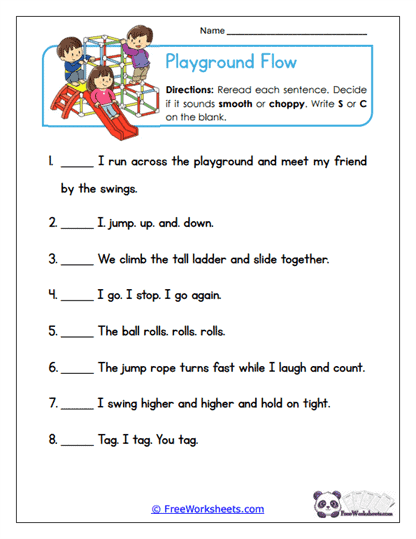
This activity helps students really hear the difference between smooth and choppy reading. At this age, many readers still sound a bit robotic, so this kind of practice is very helpful. Students read short sentences and decide if they sound smooth or not. It’s a simple idea, but it really builds awareness of how reading should sound.
Curriculum and Grade Alignment
This worksheet supports Grade 2 fluency by focusing on phrasing and expression. It aligns with Common Core RF.2.4, especially reading with appropriate expression. It also connects to TEKS fluency standards.
Student Tasks
Students read each sentence and decide if it sounds smooth or choppy. They mark their answer using “S” or “C.” This helps them think about pacing and phrasing while reading.
Common Challenges and Misconceptions
Some students may guess instead of actually reading the sentence aloud. Others may not yet recognize what “smooth” reading sounds like. Modeling a few examples out loud can really help here.
Implementation Guidance
Teachers can use this as a quick fluency warm-up. It works great as a whole-group activity where students read together and discuss. Parents can use it at home to practice reading out loud and listening carefully.
Details and Features
The worksheet includes short, simple sentences and clear directions. It’s quick to complete and easy to understand. It focuses on listening and reading skills together.
Curriculum Overlap
Understanding smooth reading supports comprehension and speaking skills. It helps students sound more natural when reading aloud. It also builds confidence in communication.
- Improves oral reading
- Builds listening skills
- Supports comprehension
- Strengthens expression