
About This Worksheet
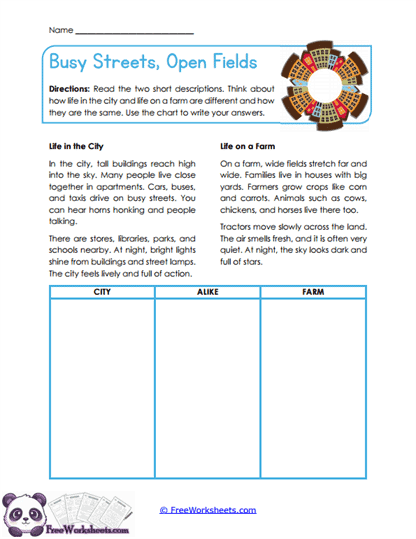
In this comparison activity, students explore how two environments are different while also noticing what they share. It is designed for Grade 2 learners who are building their understanding of how to organize ideas side by side. Students read about life in a city and life on a farm and then sort their observations into categories. For example, one setting may be noisy while the other is quiet, but both are places where people live.
Curriculum and Grade Alignment
This worksheet supports Grade 2 students in comparing two informational texts. It focuses on identifying similarities and differences across topics. It aligns with Common Core RI.2.9. It also connects to TEKS comprehension standards.
Student Tasks
On this worksheet, students will read two short descriptions about different places. They use a chart to record what is unique to each setting. Then, they identify what both places have in common. This helps students think in an organized way.
Common Challenges and Misconceptions
Students may focus only on differences and forget to look for similarities. Some might place details in the wrong column. Others may need help understanding how to compare ideas. Teachers can model how to sort one example together.
Implementation Guidance
Teachers can use this worksheet during social studies or reading lessons. It works well as a class discussion followed by independent work. Parents can use it to compare places students know. It helps connect learning to real life.
Details and Features
The worksheet includes two short passages and a three-column chart. It provides clear headings for organization. The layout is simple and student-friendly. It supports both comprehension and categorizing skills.
Curriculum Overlap
Comparing places helps students understand geography and communities. This skill supports writing by organizing ideas clearly. It also builds observation and reasoning skills.
- Supports social studies learning
- Improves organization skills
- Builds observation skills
- Strengthens reasoning