
About This Worksheet
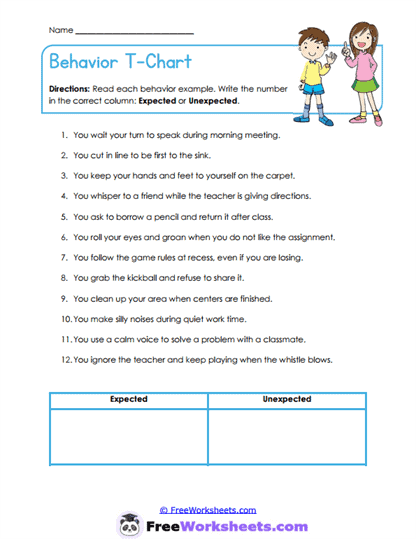
This worksheet is a sorting activity that helps students categorize behaviors into expected and unexpected groups. It is designed for Grades 1-8 and builds skills in understanding social expectations. Students read behavior examples and place them into the correct column. For example, “waiting your turn” becomes “expected behavior.” This activity reinforces appropriate classroom actions.
Curriculum and Grade Alignment
This worksheet supports social-emotional learning across elementary and middle grades. The main goal is helping students distinguish between positive and negative behaviors. Students should already understand basic classroom expectations before completing this activity. It aligns with SEL competencies such as responsible decision-making and self-management. It also connects to classroom behavior standards.
Student Tasks
On this worksheet, students will read a list of behavior statements. They will sort each statement into either the expected or unexpected column. Students must think about how each action fits classroom rules. This requires careful reading and reasoning. The task helps students apply behavior expectations.
Common Challenges and Misconceptions
Students may place behaviors incorrectly if they do not fully understand the situation. Some learners might rush and not read each example carefully. Others may rely on guesswork instead of reasoning. It is also common to misunderstand behaviors that depend on context. Teachers can help by reviewing examples and discussing choices.
Implementation Guidance
Teachers can use this worksheet during lessons on classroom expectations and SEL. It works well as guided practice or independent work. In small groups, students can compare their answers and explain their thinking. Parents or homeschool educators can use it to reinforce behavior understanding at home. Reviewing responses together helps build confidence.
Details and Features
This worksheet includes a T-chart format for sorting behaviors. It provides a list of clear and relatable examples. The layout is simple and easy to follow for students. It is designed for printing and classroom use with clean formatting. The activity encourages organization and critical thinking.