
About This Worksheet
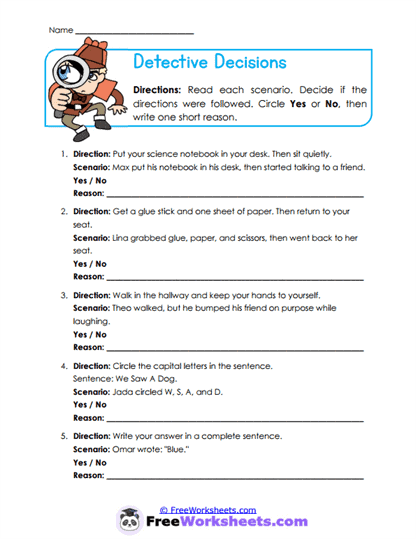
This worksheet is a scenario-based direction analysis activity designed to strengthen students’ ability to determine whether instructions were followed correctly. Students read a direction, then analyze a short scenario describing what a character did. Intended for grades 2-4, it builds careful reading, reasoning, and written explanation skills. The activity requires learners to evaluate actions against clearly stated expectations. For example, if the direction says to circle capital letters and a student circles lowercase letters, students must recognize the error. This detective-style format reinforces close reading and thoughtful decision-making.
Curriculum and Grade Alignment
This worksheet aligns with upper elementary reading standards focused on analyzing details and evaluating comprehension. The primary learning objective is helping students determine accuracy when comparing actions to instructions. Students should demonstrate strong reading fluency and the ability to write short explanations. The content supports Common Core Reading Standards RL.2.1 and RL.3.1, which emphasize asking and answering questions about key details in text. It also strengthens executive functioning skills such as attention to detail and self-monitoring. This resource promotes accountability and analytical thinking across academic subjects.
Student Tasks
On this worksheet, students will read a stated direction for a classroom or academic task. They then read a scenario describing what a character did in response. Students decide whether the directions were followed by circling Yes or No. After making their choice, they write a brief reason explaining their answer. Careful comparison between the instruction and the scenario is required. The task strengthens evaluation and justification skills.
Common Challenges and Misconceptions
Students may circle Yes or No correctly but struggle to explain their reasoning clearly. Some learners might overlook specific wording in the original direction. Others may focus on partial correctness rather than full completion of the task. Confusion can occur when multiple details are included in one instruction. Additionally, rushing through the reading may lead to incorrect evaluations. Teachers can model how to reference exact phrases from the direction when writing explanations.
Implementation Guidance
Teachers can use this worksheet during literacy lessons focused on close reading and critical thinking. It works effectively as independent practice after modeling direction analysis. Small-group discussions encourage students to explain their reasoning aloud. Parents and homeschool educators may use this activity to reinforce careful reading and academic accountability. Encouraging students to underline key instruction words improves comprehension. This worksheet also prepares students for test questions requiring justification.
Details and Features
The worksheet includes clearly structured direction-and-scenario pairs. Each item provides Yes/No response options and space for a written reason. The layout supports organized comparison and explanation. The black-and-white printable format ensures easy classroom copying. Scenarios reflect realistic classroom tasks. Its design promotes analytical reasoning and written response development.