
About This Worksheet
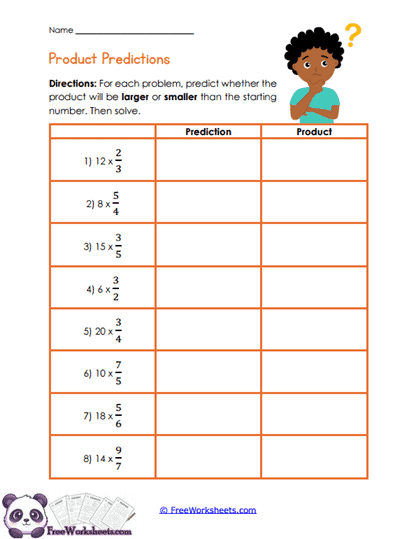
This worksheet teaches students to predict whether multiplying by a fraction will make a starting number larger or smaller. Students make the prediction first and then solve the multiplication problem to check their thinking. For example, 12 multiplied by ⅔ will be smaller than 12 because ⅔ is less than 1. This approach helps students understand scaling instead of treating fraction multiplication as only a calculation rule.
Curriculum and Grade Alignment
This activity is written for fifth-grade math and closely supports CCSS.MATH.CONTENT.5.NF.B.5, which asks students to interpret multiplication as scaling. Students should already know how to compare fractions with 1 and multiply a whole number by a fraction. The next skill is using this reasoning in word problems, estimation, and more advanced fraction situations. This worksheet strengthens the habit of thinking about the size of an answer before calculating it.
Student Tasks
On this worksheet, students will look at eight whole-number and fraction multiplication expressions. Before solving, they predict whether the product will be larger or smaller than the starting number. They then calculate the product and record it in the final column. This allows students to compare their prediction with the actual answer and see whether their scaling reasoning was correct.
Common Challenges
Some students may skip the prediction and go straight to the multiplication. Others may still believe that every multiplication problem should produce a larger answer. Fractions greater than 1 can also be confusing when students do not recognize them as scale factors that enlarge a number. Teachers can help by requiring students to compare the fraction with 1 before they calculate.
Teaching Tips
This worksheet works best when students are encouraged to explain each prediction before solving. A teacher might pause after every few problems and ask students how they knew whether the answer would grow or shrink. Parents can cover the product column at first and have the child make all the predictions before doing any multiplication. This keeps the reasoning step from being lost once students begin calculating.
Worksheet Features
The worksheet uses a three-column table with the multiplication expression, prediction, and final product clearly separated. Eight problems include a variety of fractions greater than and less than 1. The layout helps students see that prediction and computation are two different parts of the thinking process. The page is useful for class practice, homework, formative assessment, or review before more difficult fraction scaling work.