
About This Worksheet
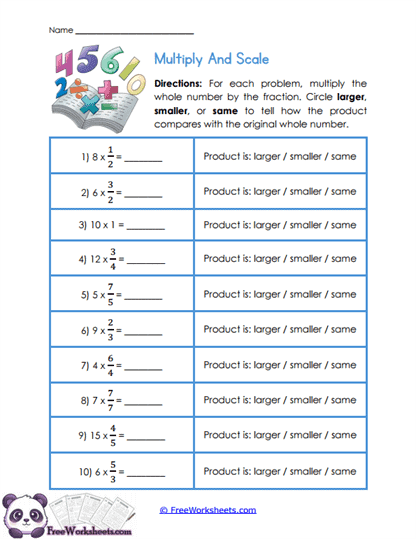
This worksheet helps students see how multiplying a whole number by a fraction changes the size of the answer. The main idea is that a fraction less than 1 makes the product smaller, a fraction equal to 1 keeps it the same, and a fraction greater than 1 makes it larger. For example, 8 becomes 4 when multiplied by 12\frac{1}{2}. This gives students a simple way to connect fraction multiplication with the idea of scaling.
Curriculum and Grade Alignment
This activity is designed for fifth-grade math and supports CCSS.MATH.CONTENT.5.NF.B.5, which focuses on interpreting multiplication as scaling. Students should already know how to multiply a whole number by a fraction and compare fractions to 1. The next step is using this same reasoning to estimate products and solve more complex fraction word problems. This worksheet gives students practice noticing the size of the scale factor before deciding what should happen to the product.
Student Tasks
On this worksheet, students will multiply each whole number by the fraction shown beside it. After finding the product, they decide whether the answer is larger than, smaller than, or the same as the original whole number. The problems include fractions that are less than 1, equal to 1, and greater than 1. Students therefore practice both computation and the reasoning behind how a fraction changes a quantity.
Common Challenges
Some students may think multiplication always makes a number larger. Others may focus only on the numerator and ignore whether the entire fraction is greater than or less than 1. A fraction such as 45\frac{4}{5} may also look large to a child even though it is still less than 1. Teachers can help by having students compare each fraction with 1 before doing any multiplication.
Teaching Tips
This worksheet works well after students have learned how to multiply whole numbers by fractions. A teacher can model one example from each category: less than 1, equal to 1, and greater than 1. At home, a parent can ask, “Is this fraction smaller than one, equal to one, or bigger than one?” before the child solves. That quick question helps students predict what the answer should look like and catch mistakes.
Worksheet Features
The worksheet includes ten fraction multiplication problems with a clear comparison choice beside each answer. The scale factors vary enough to give students repeated practice with all three possible product relationships. Students must calculate and then interpret their result, which makes the page more meaningful than basic multiplication practice alone. The format works well for classwork, homework, review, or a quick understanding check.