
About This Worksheet
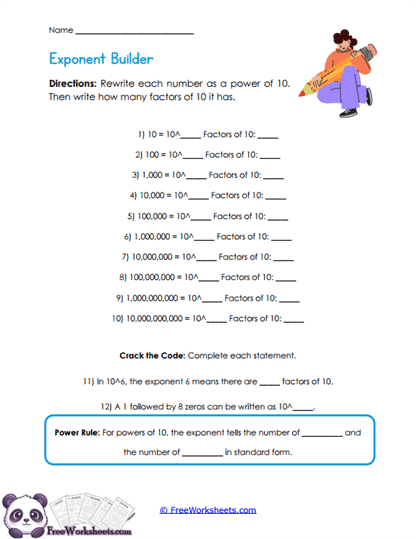
This worksheet teaches students how powers of ten connect to standard numbers and repeated factors of 10. Students look at numbers such as 10, 100, 1,000, and larger values, then rewrite each one using exponent form. For example, 1,000 becomes 10310^3 because it contains three factors of 10. This activity makes the meaning of an exponent much more concrete by tying the exponent directly to the number of tens being multiplied.
Curriculum and Grade Alignment
This fifth-grade worksheet supports CCSS.MATH.CONTENT.5.NBT.A.2 by helping students recognize powers of ten and connect exponents to place-value patterns. Students should already know how to read large whole numbers and understand repeated multiplication. After mastering this skill, they will be more prepared to use exponents when multiplying and dividing by powers of ten. The worksheet also supports early algebraic thinking because students are moving between different ways of representing the same value.
Student Tasks
On this worksheet, students will rewrite each standard number as a power of ten. They will then state how many factors of 10 are represented in each number. The problems increase from 10 up through very large powers, giving students repeated practice with the same pattern. At the end, students complete short statements about exponents and use what they learned to explain the general rule.
Common Challenges
Some students may confuse the exponent with the number of zeros instead of understanding that it shows the number of factors of 10. In powers of ten, those two ideas are closely connected, which can make the misunderstanding easy to miss. Students may also accidentally count the digit 1 along with the zeros when identifying the exponent. A helpful teaching move is to write out repeated multiplication for a few examples before asking students to use exponent form.
Teaching Tips
This worksheet is a strong follow-up to a lesson on repeated multiplication and exponent notation. Teachers can begin by writing 10 × 10 × 10 on the board and asking students how many factors of 10 they see. Parents can do the same thing at home with a few smaller examples before moving to the larger numbers on the page. Encourage your child to explain why the exponent works rather than simply copying the number of zeros.
Worksheet Features
The page gives students ten standard-form numbers to rewrite using exponents and identify by number of factors. The values grow steadily, helping children notice a clear and predictable pattern. A short “crack the code” section gives extra practice with the meaning of exponent notation. The final rule asks students to summarize the connection between powers of ten, factors, and standard form.