
About This Worksheet
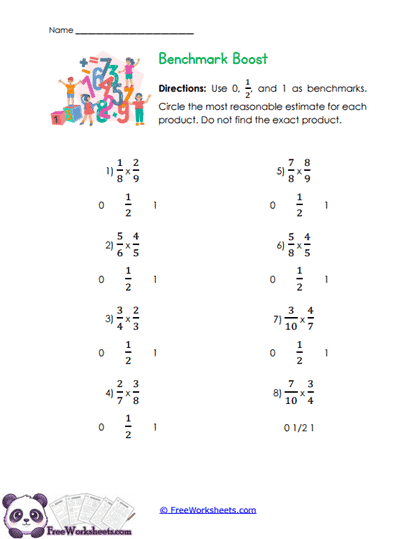
Benchmark Sense is a fifth grade estimation activity that asks students to use 0, 1/2, and 1 as benchmarks for fraction products. Each multiplication problem includes two fractions, and students decide whether the product is closest to 0, 1/2, or 1. They do not calculate the exact answer. This helps children build a stronger feel for fraction size and recognize whether a product should be very small, about half, or close to one whole.
Curriculum and Grade Alignment
This worksheet is intended for fifth grade learners who are developing estimation skills with fraction multiplication. The main goal is to help students use familiar benchmark fractions to judge the approximate size of a product. Before beginning, your child should be able to compare fractions with 0, 1/2, and 1 and understand how multiplying by a fraction less than 1 affects a number. The next step is estimating products in word problems and using estimates to check exact solutions. This activity supports fraction sense, estimation, benchmarks, and multiplication reasoning.
Student Tasks
Students will estimate eight fraction products. For each one, they circle 0, 1/2, or 1 depending on which benchmark is closest to the product. The problems include pairs such as 1/8 × 2/9, 5/6 × 4/5, 3/4 × 2/3, and several others. Students use the relative size of each factor to make the estimate instead of multiplying exactly.
Common Challenges and Misconceptions
Some students may focus on only one factor and ignore the other. Others may think that multiplying two fractions near 1 must always give exactly 1. A child may also struggle to recognize when the product of two small fractions should be much closer to 0 than to 1/2. Encourage your child to estimate each factor first and then think about how much smaller the product will become.
Implementation Guidance
Teachers can use this worksheet before exact multiplication to build prediction skills. Parents can ask the child to place each factor mentally on a number line from 0 to 1 before choosing a benchmark for the product. If both fractions are small, the product will be even smaller. If both are close to 1, the product will also be fairly close to 1.
Details and Features
This worksheet includes eight benchmark-estimation problems arranged in two columns. Each problem provides the choices 0, 1/2, and 1. Students circle the most reasonable estimate without finding the exact product. The printable supports benchmark fractions, estimation, fraction magnitude, and product reasoning.