
About This Worksheet
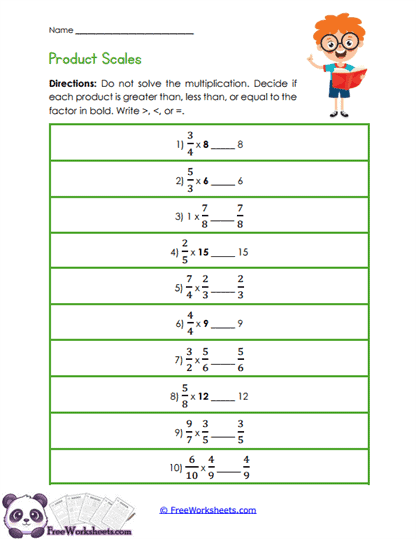
Product Compare is a fifth grade reasoning activity that asks students to judge how multiplying by a fraction changes a number without solving the multiplication exactly. Each problem shows a fraction times a whole number or another fraction, followed by the original factor in bold. Students decide whether the product is greater than, less than, or equal to that bold value. This helps children understand the effect of multiplying by numbers that are less than 1, equal to 1, or greater than 1.
Curriculum and Grade Alignment
This worksheet is made for fifth grade learners who are building stronger fraction sense and scaling reasoning. The main goal is to help students predict the size of a product before calculating it. Before using this page, your child should understand that multiplying by a fraction less than 1 usually makes a number smaller, while multiplying by 1 keeps it the same. The next step is using this reasoning to estimate products and check exact answers. This activity supports fraction multiplication, comparison, scaling, and number sense.
Student Tasks
Students will complete ten comparison problems. For each one, they study a multiplication expression and decide whether the product is greater than, less than, or equal to the bold factor. The problems include fractions such as 3/4, 5/6, 7/8, and others. Students write <, >, or = without calculating the exact product. This keeps the focus on reasoning about magnitude.
Common Challenges and Misconceptions
Some students may assume multiplication always makes a number larger. Others may compare only the numerators or denominators instead of thinking about the fraction as a whole. A child may also forget that multiplying by 1 leaves a value unchanged. Encourage your child to first decide whether the fraction being multiplied is less than 1, equal to 1, or greater than 1. That usually tells them how the product will compare.
Implementation Guidance
Teachers can use this worksheet before or after direct fraction multiplication practice. Parents can ask the child to explain each comparison in words before writing the symbol. For example, “Three-fourths is less than one, so three-fourths of 8 must be less than 8.” This simple explanation reinforces the scaling idea.
Details and Features
This worksheet includes ten green-bordered comparison problems in a single-column format. Students do not solve the multiplication exactly and instead write <, >, or = based on product size. The printable supports fraction magnitude, scaling, comparison symbols, and multiplication reasoning.