
About This Worksheet
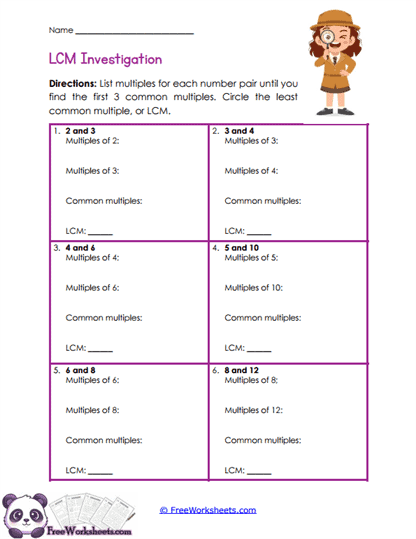
Multiple Investigator is a fifth grade activity that teaches students how to find the least common multiple by comparing multiplication patterns. Each problem gives a pair of numbers and asks students to list multiples of both until at least three common multiples appear. Students circle the shared values and then identify the smallest one as the LCM. For example, multiples of 2 and 3 first meet at 6, making 6 the least common multiple. This helps children understand LCM as a pattern that naturally appears in two number sequences.
Curriculum and Grade Alignment
This worksheet is made for fifth grade learners who are ready to use multiple lists to identify least common multiples. The main goal is to help students recognize shared multiples and choose the smallest one. Before using this page, your child should be comfortable generating multiples through repeated multiplication. The next step is using LCM with fraction denominators and more advanced number relationships. This activity supports multiplication patterns, common multiples, and number sense.
Student Tasks
Students will complete six LCM investigations using the pairs 2 and 3, 3 and 4, 4 and 6, 5 and 10, 6 and 8, and 8 and 12. For each problem, students list multiples of both numbers, identify the first three shared values, and write the least common multiple. The worksheet gives plenty of room for students to see the two sequences side by side.
Common Challenges and Misconceptions
Some students may stop as soon as they find one common multiple without checking whether it is the least one. Others may list factors instead of multiples. A child may also skip multiples and accidentally miss the first common value. Encourage your child to list multiples in order and compare the two rows from smallest to largest. The first shared number is the LCM.
Implementation Guidance
Teachers can use this worksheet after students have practiced basic multiple sequences. Parents can have the child use skip counting aloud while filling each list. If a number appears in both sequences, circle it right away. Once the first three common multiples are visible, ask which one is smallest. This makes the idea of “least” very clear.
Details and Features
This worksheet includes six purple-bordered LCM investigations in a two-column layout. Each problem provides separate spaces for the multiples of both numbers, common multiples, and the final LCM. The printable supports least common multiple, multiplication fluency, pattern recognition, and comparison.