
About This Worksheet
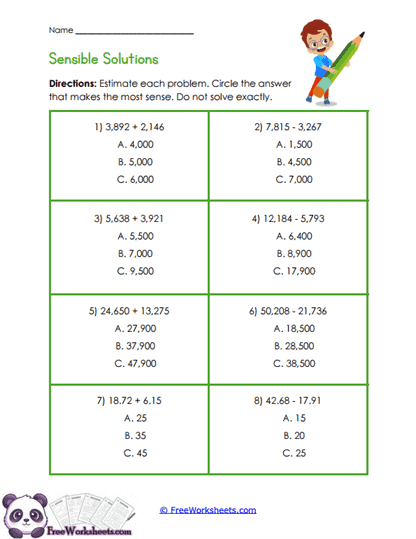
Estimate Sense is a fifth grade activity that helps students decide which answer is reasonable without solving every problem exactly. Each question gives an addition or subtraction expression and three possible answers. Students use estimation, rounding, and number sense to choose the value that makes the most sense. For example, 3,892 + 2,146 is a little more than 6,000, so an answer near 6,000 is much more reasonable than one near 4,000. This teaches children to judge an answer before relying on exact calculation.
Curriculum and Grade Alignment
This worksheet is made for fifth grade learners who are strengthening estimation with whole numbers and decimals. The main goal is to help students recognize whether an answer is reasonable by using nearby friendly numbers. Before using this page, your child should understand rounding and have experience adding and subtracting larger values. The next step is using estimation automatically to check exact answers in longer problems. This activity supports number sense, rounding, mental math, and answer verification.
Student Tasks
Students will complete eight multiple-choice estimation problems. The page includes large whole-number addition and subtraction along with decimal problems such as 18.72 + 6.15 and 42.68 − 17.91. Students estimate each result and circle the choice that is closest to what the answer should be. They are specifically told not to solve exactly, so the focus remains on judging size and reasonableness.
Common Challenges and Misconceptions
Some students may try to calculate every problem exactly because they are more comfortable with the standard algorithm. Others may round too aggressively and choose an answer that is not close enough. Decimal problems can also cause students to lose track of place value. Encourage your child to round to convenient numbers and ask, “About how much should this be?” The goal is a sensible estimate, not a perfect calculation.
Implementation Guidance
Teachers can use this worksheet to build estimation habits before or after exact computation lessons. Parents can ask the child to explain why one choice is clearly too high or too low before selecting an answer. For decimal problems, rounding to nearby whole numbers can make the estimate much easier. This helps students see estimation as a useful thinking tool rather than extra work.
Details and Features
This worksheet includes eight green-bordered multiple-choice problems arranged in a two-column grid. The problems mix whole numbers and decimals and require either addition or subtraction. Each item provides three possible answers, and students circle the most reasonable one. The printable supports estimation, rounding, decimal sense, and mathematical judgment.