
About This Worksheet
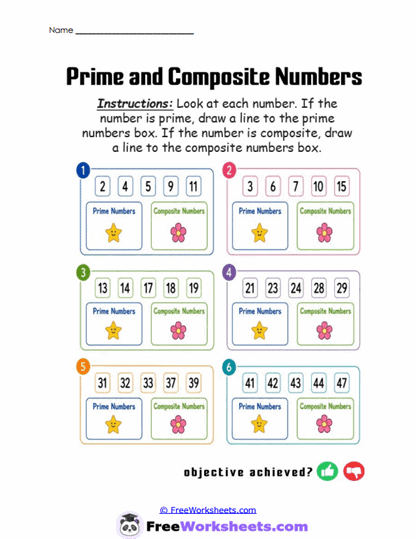
Prime Composite Sort is a fourth grade classification activity that asks students to sort individual numbers into prime and composite categories. Each problem box presents five numbers along the top and two labeled areas below: Prime Numbers and Composite Numbers. Students study each number and draw a line connecting it to the correct category. This gives children direct practice applying the definitions of prime and composite instead of simply looking for an outlier.
Curriculum and Grade Alignment
This worksheet is made for fourth grade learners who are ready to classify several numbers independently. The main goal is to help students decide whether each value has exactly two factors or more than two factors. Before using this page, your child should understand basic factor pairs and know the definitions of prime and composite numbers. The next step is counting primes and composites in larger ranges and identifying them without visual sorting supports. This activity supports factors, divisibility, number classification, and mathematical vocabulary.
Student Tasks
Students will sort thirty numbers across six activity boxes. Each box contains five values, including numbers such as 2, 4, 5, 9, 11, 3, 6, 7, 10, 15, 13, 14, 17, 18, 19, 21, 23, 24, 29, 31, 32, 33, 37, 39, 41, 42, 43, 44, and 47. Students draw lines from each number to either the Prime Numbers box or the Composite Numbers box. This repeated sorting helps students become more fluent with common primes through the 40s.
Common Challenges and Misconceptions
Some students may incorrectly place 1 with the prime numbers, though this particular page focuses on values that can be classified directly as prime or composite. Others may mistake odd composite numbers such as 9, 15, 21, 33, or 39 for primes. A child may also forget that all even numbers greater than 2 are composite. Encourage your child to use quick divisibility checks first and then test less obvious numbers with factor pairs.
Implementation Guidance
Teachers can use this worksheet after students have practiced identifying factors and classifying individual numbers. It works well as independent practice because the prime and composite categories are clearly labeled in every box. Parents can ask the child to say the factor evidence aloud before drawing each line. For example, “21 is composite because 3 × 7 = 21.” This reinforces the reason behind the classification.
Details and Features
This worksheet includes six colorful sorting boxes with five numbers in each. Every box contains separate Prime Numbers and Composite Numbers targets, and students draw lines to classify each value. The numbers range from 2 through 47. The printable supports prime numbers, composite numbers, factors, divisibility, and classification fluency.