
About This Worksheet
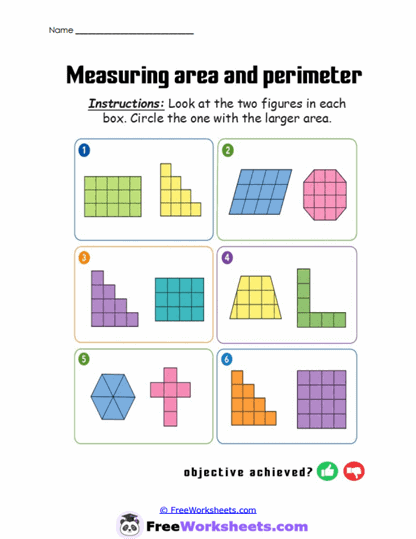
Grid Area Check is a fourth grade visual measurement activity that asks students to compare the areas of two figures built from equal-sized units. Each pair includes shapes arranged in different ways, such as stair-step figures, rectangles, crosses, or tiled polygons. Students count the unit pieces in each figure and circle the one with the larger area. This helps children understand that area depends on how much space a figure covers, not on whether it looks taller, wider, or more complicated.
Curriculum and Grade Alignment
This worksheet is made for fourth grade learners who are strengthening their understanding of area through unit models. The main goal is to help students compare areas by counting equal units accurately. Before using this page, your child should understand that area measures the inside of a figure and is expressed in square units. The next step is using multiplication to find the area of rectangles and decomposing irregular figures into simpler parts. This activity supports area measurement, visual reasoning, and spatial awareness.
Student Tasks
Students will solve six area-comparison problems. Each box contains two tiled figures made from equal-sized units. Students count the units in each shape, compare the totals, and circle the figure with the greater area. Some of the shapes are rectangles, while others have stair-step or irregular arrangements. This gives students practice recognizing that different-looking shapes can still be compared fairly when the units are the same size.
Common Challenges and Misconceptions
Some students may choose the shape that looks bigger without actually counting the units. Others may count edges instead of interior pieces and accidentally find something closer to perimeter. A child may also skip or double-count units in irregular figures. Encourage your child to count row by row or break the shape into smaller sections before adding the totals. This keeps the work organized.
Implementation Guidance
Teachers can use this worksheet after students have worked with simple rectangular area models. It works well as a transition into irregular-area thinking because the shapes are not all standard rectangles. Parents can ask the child to write the unit count beside each figure before circling the larger one. If two totals are close, recount using a different method to check. This helps build confidence and accuracy.
Details and Features
This worksheet includes six pairs of tiled figures in color-coded boxes. The shapes use equal-sized units but vary in arrangement and overall appearance. Students circle the figure with the larger area in each pair. The printable supports area comparison, unit counting, irregular figures, and visual measurement.