
About This Worksheet
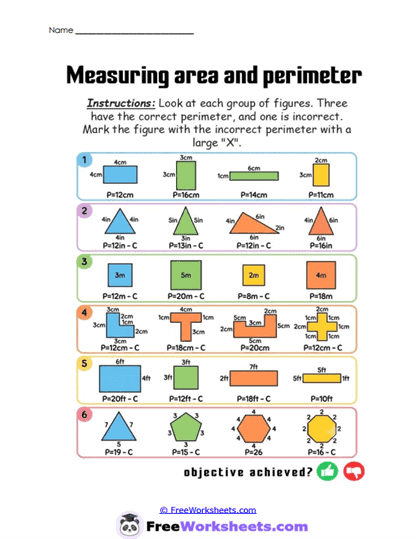
Perimeter Error Hunt is a fourth grade measurement activity that asks students to inspect groups of shapes and find the one incorrect perimeter in each group. Every set contains several figures with side lengths already labeled and perimeter values already written below them. Three answers are correct and one is wrong. Students calculate or check the distance around each figure and mark the incorrect one with a large X. This helps children practice perimeter while also developing strong error-checking habits.
Curriculum and Grade Alignment
This worksheet is made for fourth grade learners who are practicing perimeter with a variety of polygons. The main goal is to help students understand that perimeter is found by adding all of the outside side lengths. Before using this page, your child should be comfortable adding whole numbers and identifying the outer edges of rectangles, triangles, squares, and other shapes. The next step is calculating missing side lengths or solving perimeter word problems independently. This activity supports perimeter, shape recognition, addition, and mathematical verification.
Student Tasks
Students will work through six groups of figures. Each group contains four shapes with labeled side lengths and a stated perimeter. Students check each perimeter by adding the sides and then place an X on the figure whose perimeter is incorrect. The page includes rectangles, triangles, squares, crosses, pentagons, and other polygons. This gives students repeated practice across several different figure types instead of relying only on rectangles.
Common Challenges and Misconceptions
Some students may multiply side lengths when they should add them, especially when looking at rectangles. Others may accidentally include an interior line or overlook one outside edge on a more complicated shape. A child may also assume similarly shaped figures have the same perimeter. Encourage your child to trace the outside edge with a finger and add every side once. This helps keep perimeter focused on the boundary of the figure.
Implementation Guidance
Teachers can use this worksheet after students have learned how to calculate perimeter and are ready for error analysis. It works well as independent review or a quick formative assessment because students must verify several answers rather than simply produce one. Parents can have the child cover the printed perimeter and calculate it first, then uncover and compare. This makes the checking process more deliberate.
Details and Features
This worksheet includes six colored groups of four figures each. Every figure has labeled side lengths and a printed perimeter, with exactly one incorrect answer in each group. The mixture of polygons and units gives broad perimeter review. The printable supports perimeter calculation, error detection, side-length addition, and geometry reasoning.