
About This Worksheet
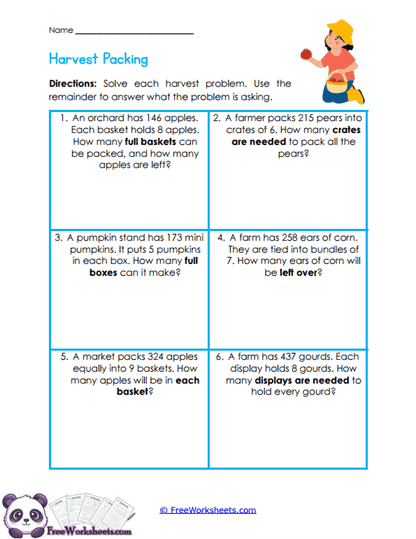
Harvest Division Stories is a fourth grade word-problem activity that uses farm and harvest situations to practice division with remainders. Students read each story, divide the total into equal groups, and then decide what the quotient and remainder mean in that situation. Some problems ask how many full groups can be made, while others ask how many objects are left over or whether an additional container is needed. For example, 146 apples packed into baskets of 8 will leave some apples after the full baskets are filled. This helps children understand that remainders have real meanings and cannot always be handled the same way.
Curriculum and Grade Alignment
This worksheet is made for fourth grade learners who are ready to interpret division and remainders in real-world contexts. The main goal is to help students connect the numerical remainder with what the story is actually asking. Before using this page, your child should know how to divide multi-digit numbers by one-digit divisors and record remainders. The next step is deciding whether to ignore, use, or round up because of the remainder. This activity supports division, remainder interpretation, and word-problem reasoning.
Student Tasks
Students will solve six harvest-themed division stories. The problems involve apples packed in baskets, pears packed into crates, pumpkins placed into boxes, corn bundled together, apples divided among baskets, and gourds arranged on display. Students calculate each quotient and remainder, then answer the specific question in the story. Some questions ask for full groups, while others ask how many items remain. This builds computation and contextual reasoning.
Common Challenges and Misconceptions
Some students may write the quotient and remainder but not answer what the story actually asks. Others may always include the remainder in the same way, even when the problem asks only for full boxes or how many items are left over. A child may also fail to round up when every item must be packed into a container. Encourage your child to solve the division first, then reread the final question and decide what the remainder represents. This makes the answer fit the situation.
Implementation Guidance
Teachers can use this worksheet after students know how to calculate remainders but before moving to more complex multi-step division problems. It works especially well for discussing why remainders are interpreted differently depending on context. Parents can ask the child to finish the sentence, “The remainder means…” after every problem. If the story asks how many containers are needed, discuss whether a partly filled final container still counts. This helps make remainder interpretation practical and memorable.
Details and Features
This worksheet includes six harvest-themed division word problems in a blue two-column grid. Each problem uses a multi-digit dividend and a one-digit divisor and asks students to interpret the quotient or remainder in context. The farm and harvest settings provide clear examples of equal grouping and leftovers. The printable supports division with remainders, word-problem comprehension, and real-world mathematical reasoning.