
About This Worksheet
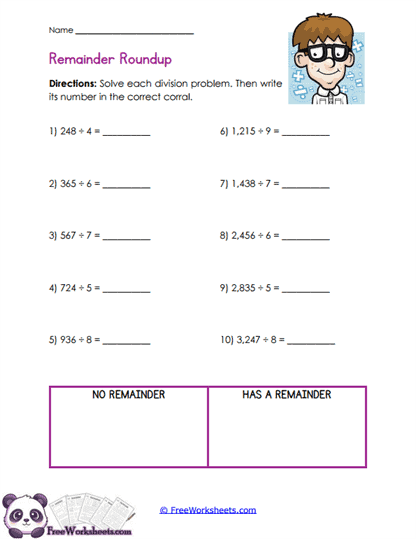
Remainder Sort is a fourth grade division activity that asks students to solve division problems and then classify them according to whether the quotient has a remainder. Each equation must be worked out first, after which students write its problem number in either the No Remainder or Has a Remainder box. This helps children pay attention to what happens after equal groups are made and recognize when a dividend does not divide evenly. It also strengthens the idea that a remainder must always be smaller than the divisor.
Curriculum and Grade Alignment
This worksheet is made for fourth grade learners who are developing fluency with division involving remainders. The main goal is to help students distinguish between exact division and division that leaves an amount over. Before using this page, your child should know basic multiplication and division facts and understand what a remainder represents. The next step is interpreting remainders in word problems and deciding what the leftover amount means in context. This activity supports division fluency, remainder reasoning, and classification.
Student Tasks
Students will solve ten division problems, including examples such as 248 ÷ 4, 365 ÷ 6, 567 ÷ 7, 724 ÷ 5, 936 ÷ 8, 1,215 ÷ 9, and 3,247 ÷ 8. After finding each quotient, students determine whether there is a remainder. They then write the problem number in the appropriate sorting box at the bottom of the page. This combines computation with a second reasoning step.
Common Challenges and Misconceptions
Some students may stop at the whole-number quotient and forget to record the remainder. Others may write a remainder that is equal to or larger than the divisor. A child may also correctly solve the equation but place the problem number in the wrong category. Encourage your child to multiply the quotient by the divisor and compare that product with the dividend. Any leftover amount is the remainder, and it must be smaller than the divisor.
Implementation Guidance
Teachers can use this worksheet after students have been introduced to remainders. It works well as a quick review because the sorting step helps students notice which problems divide evenly. Parents can have the child solve all ten equations first and then complete the sorting in a second pass. If a remainder seems uncertain, use multiplication to check the quotient and leftover amount. This reinforces the inverse relationship between multiplication and division.
Details and Features
This worksheet includes ten division problems and two large purple sorting boxes labeled No Remainder and Has a Remainder. The dividends range from the hundreds into the thousands and use divisors from 4 through 9. The printable supports division with remainders, classification, multiplication checking, and quotient fluency.