
About This Worksheet
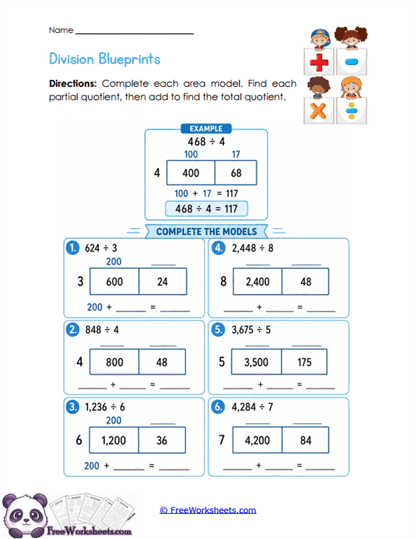
Division Models is a fourth grade activity that uses area models to show how large division problems can be split into manageable pieces. Each problem places the divisor beside a rectangle and separates the dividend into two friendly parts. Students determine the partial quotient represented by each section and then add those partial quotients to find the total answer. For example, 468 ÷ 4 can be modeled as 400 ÷ 4 plus 68 ÷ 4, giving partial quotients of 100 and 17. This makes the structure of division visible and connects the process to multiplication and area.
Curriculum and Grade Alignment
This worksheet is intended for fourth grade learners who are developing multi-digit division strategies. The main goal is to help students understand how an area model represents partial quotients and place-value decomposition. Before beginning, your child should know basic multiplication facts and understand how multiplication and division are inverse operations. The next step is creating their own area models or moving from visual models to written partial-quotient strategies. This activity supports division, area models, place value, and multiplicative reasoning.
Student Tasks
Students will complete six area-model division problems. Each one shows the divisor, the dividend, and a rectangle already separated into two parts. Students determine the missing partial quotient above each section and then add the partial quotients to find the final quotient. Problems include 624 ÷ 3, 848 ÷ 4, 1,236 ÷ 6, 2,448 ÷ 8, 3,675 ÷ 5, and 4,284 ÷ 7. This gives students practice dividing three- and four-digit numbers using a visual strategy.
Common Challenges and Misconceptions
Some students may confuse the numbers inside the model with the partial quotients written above it. Others may divide the entire dividend again after already finding the separate parts. A child may also forget that the two sections of the model must add back to the original dividend. Encourage your child to read each rectangle as “dividend part ÷ divisor = partial quotient.” Then add the quotients, not the dividend parts, to get the final answer.
Implementation Guidance
Teachers can use this worksheet after students understand multiplication area models and are beginning multi-digit division. It provides a strong visual bridge to partial quotients. Parents can cover the quotient spaces and ask the child which multiplication fact would fill each section, such as “4 times what equals 400?” This often makes the division easier to understand. Once the child is comfortable, encourage them to sketch similar models independently.
Details and Features
This worksheet includes six blue area-model problems plus a worked example. Each model separates a large dividend into two easier values and provides spaces for partial quotients and the final answer. The problems include divisors from 3 through 8 and dividends into the thousands. The printable supports area models, partial quotients, place value, and multi-digit division.