
About This Worksheet
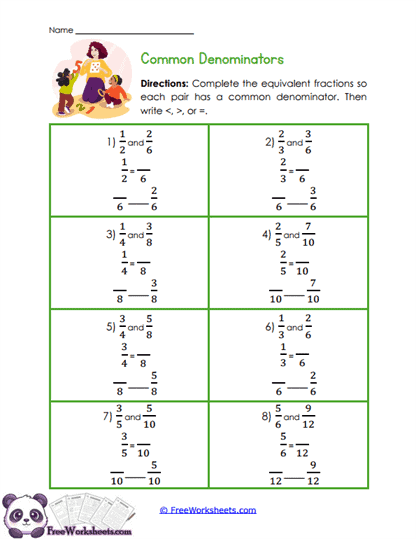
Common Denominator Builder is a fourth grade fraction comparison activity that helps students compare fractions with unlike denominators by first rewriting them with a common denominator. Each problem gives two fractions and provides space for students to create equivalent fractions before deciding whether the first value is less than, greater than, or equal to the second. For example, 1/2 and 2/6 can both be rewritten in sixths before comparing. This helps children understand why equivalent fractions make unlike-denominator comparisons easier and more reliable.
Curriculum and Grade Alignment
This worksheet is made for fourth grade learners who are ready to compare fractions using equivalent forms. The main goal is to help students create common denominators and then compare the resulting numerators. Before using this page, your child should understand equivalent fractions and know that multiplying the numerator and denominator by the same number keeps the fraction’s value unchanged. The next step is choosing common denominators independently without as much structure. This activity supports fraction equivalence, comparison, and multiplicative reasoning.
Student Tasks
Students will complete eight fraction comparisons. For each pair, they rewrite one or both fractions so both have the same denominator, then use <, >, or = to compare them. The problems include denominator pairs such as 2 and 6, 3 and 6, 4 and 8, 5 and 10, 4 and 8, 3 and 6, 5 and 10, and 6 and 12. This gives students repeated practice creating equivalent fractions and using them to make accurate comparisons.
Common Challenges and Misconceptions
Some students may change the denominator without changing the numerator by the same factor. Others may successfully create equivalent fractions but then compare the original numerators instead of the new ones. A child may also think any shared denominator will work even if the fraction was not rewritten equivalently. Encourage your child to ask, “What did I multiply the denominator by?” and then multiply the numerator by that same number. Once the denominators match, comparing the numerators becomes much easier.
Implementation Guidance
Teachers can use this worksheet after students have practiced identifying equivalent fractions. It works well as a bridge into more independent comparison of unlike denominators. Parents can have the child write a small multiplication note beside each fraction, such as “×2” or “×3,” to show how the equivalent form was created. If a problem feels difficult, use fraction bars to confirm that the rewritten fractions represent the same amounts. This helps keep the procedure connected to meaning.
Details and Features
This worksheet includes eight green-bordered fraction comparison problems. Each box provides guided space for creating equivalent fractions with a common denominator and then writing a comparison symbol. The denominators are chosen so the common denominator is straightforward to find. The printable supports equivalent fractions, common denominators, comparison symbols, and fraction reasoning.