
About This Worksheet
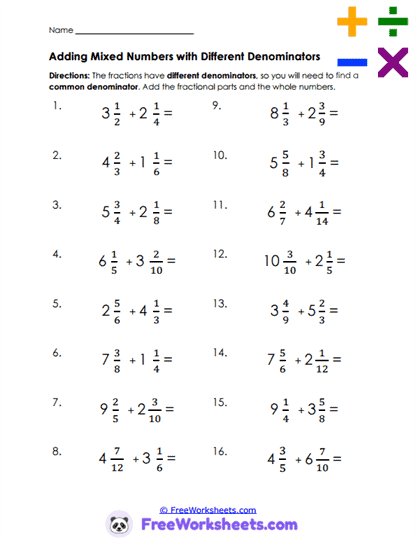
This worksheet gives students more practice adding mixed numbers with different denominators. Learners build confidence by converting fractions into equivalent forms before solving each problem. The activity strengthens understanding of fraction relationships and mixed-number operations. For example, 2 1/3 + 4 1/6 becomes 2 2/6 + 4 1/6, which equals 6 3/6 or 6 1/2. This practice supports deeper fraction fluency and mathematical reasoning.
Curriculum and Grade Alignment
The worksheet supports fraction addition skills involving unlike denominators and mixed numbers. Students should already know how to identify equivalent fractions and simplify answers. The primary learning goal is solving mixed-number equations accurately using common denominators. This skill prepares learners for regrouping and more advanced fraction operations later in the curriculum. The activity aligns with Common Core standard 5.NF.A.1 and TEKS 5.3H.
Student Tasks
On this worksheet, students will
find common denominators before adding mixed numbers together. Students rewrite fractions as equivalent fractions to make addition possible. Learners solve each equation by combining whole numbers and fractional parts separately. Several problems require simplifying fractions or converting improper fractions into mixed numbers. Students also practice checking their work for accuracy and reasonableness.
Common Challenges and Misconceptions
Some students forget to convert both fractions to the same denominator before adding. Others may correctly find equivalent fractions but make arithmetic mistakes during addition. Learners sometimes simplify too early and create confusion in later steps. A few students may also struggle with keeping their work organized across multiple steps. Teachers can support understanding by modeling one complete example from start to finish before independent practice.
Implementation Guidance
Teachers may use this worksheet during fraction units, review lessons, or guided math centers. The activity works well for reinforcing classroom instruction and strengthening procedural fluency. Parents and homeschool educators can encourage students to explain each step aloud while solving. Visual fraction tools may help children better understand why common denominators are necessary. The consistent structure allows learners to build confidence through repetition.
Details and Features
This worksheet contains sixteen mixed-number addition problems with unlike denominators. Clear formatting and large spacing support neat student work and easier problem solving. The printable design makes it useful for homework, classwork, tutoring sessions, or intervention programs. Child-friendly graphics help maintain student engagement while keeping the focus on math practice. The progression of problems encourages steady skill development.