
About This Worksheet
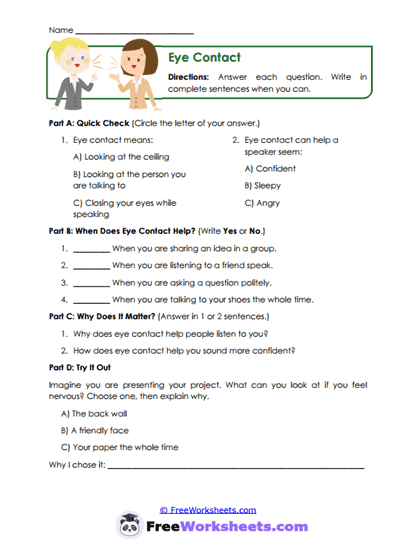
This worksheet is a social-emotional learning activity that helps students understand the importance of eye contact in communication. It focuses on when and why eye contact helps speakers sound confident and engaged. The subject area is SEL and communication, designed for grades 3-6. Students learn that eye contact shows attention and respect. For example, “looking at the person you are talking to” signals confidence and listening.
Curriculum and Grade Alignment
This worksheet supports students in developing effective speaking and listening behaviors. It builds awareness of nonverbal communication skills. Students should already understand basic conversation rules before completing this activity. The next step is applying these skills consistently in real interactions. It aligns with CCSS.ELA-LITERACY.SL.3.1 and TEKS 110.6(b)(1), which emphasize communication and listening skills.
Student Tasks
On this worksheet, students will answer questions about what eye contact means and why it matters. They will identify when eye contact is helpful in conversations. Students also respond to short written questions using complete sentences. In the final section, they choose and explain what they can look at if they feel nervous. This encourages both understanding and personal reflection.
Common Challenges and Misconceptions
Some students may think eye contact means staring, which can feel uncomfortable. Others might not recognize when eye contact is appropriate. It’s also common to feel nervous and avoid eye contact completely. A few students may struggle to explain their answers in writing. Demonstrating natural eye contact can help students feel more comfortable.
Implementation Guidance
Teachers can use this worksheet during SEL lessons or before presentations. It works well alongside modeling and role-play activities. Parents can reinforce this skill by encouraging eye contact during conversations at home. Practicing in a supportive environment can build confidence. This is an important skill for both school and everyday communication.
Details and Features
The worksheet includes a mix of multiple-choice and written response questions. It provides opportunities for both understanding and reflection. The layout is simple and easy for students to follow. It supports both communication and writing skills. The printable format makes it convenient for classroom or home use.