
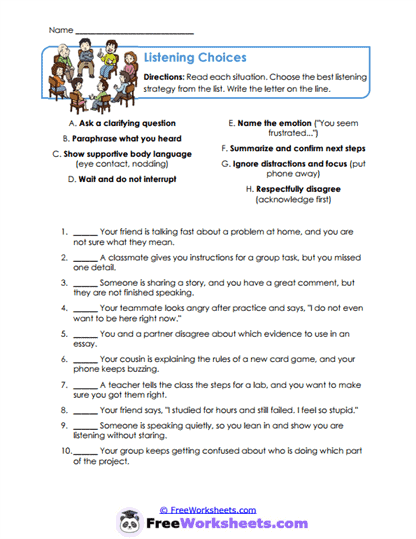
About This Worksheet
This worksheet is a communication sorting activity that helps students classify verbal and nonverbal listening signals. It focuses on recognizing how different types of responses show engagement in a conversation. Students sort examples into categories such as spoken responses and body language cues. For example, nodding becomes a nonverbal signal, while saying “I understand” becomes a verbal signal. This strengthens awareness of how listening is shown in different ways.
Curriculum and Grade Alignment
This worksheet is designed for grades 4 through 7 and supports communication and social-emotional learning skills. The main goal is to help students distinguish between verbal and nonverbal listening behaviors. Students should already have basic knowledge of conversation skills before completing this activity. It aligns with CCSS.SL.4.1, which focuses on collaborative discussions and effective participation. In Texas, it connects to TEKS 110.6(b)(1) related to listening and speaking expectations.
Student Tasks
On this worksheet, students will read different listening signals and sort them into the correct category. They must decide whether each example is verbal or nonverbal. Some tasks require careful thinking about signals that could fit both categories depending on context. Students will organize their answers clearly in the provided sections. The activity encourages classification and deeper understanding of communication behaviors.
Common Challenges and Misconceptions
Students may confuse verbal and nonverbal signals when actions include both speaking and movement. Some might think all positive behaviors belong in the same category. Others may struggle with signals that are less obvious, such as tone of voice. There can also be difficulty understanding that both types are important for active listening. Teachers should model examples and discuss each category before students begin.
Implementation Guidance
Teachers can use this worksheet during lessons on communication or active listening skills. It works well as a small group activity where students discuss their sorting choices. Role-playing can help reinforce understanding of each signal type. At home, parents can use it to talk about how listening looks and sounds in conversations. This activity supports both recognition and application of listening skills.
Details and Features
The worksheet includes clearly labeled categories and a list of listening signals to sort. It is designed as a one-page printable for easy use. The layout supports visual organization and student engagement. Simple formatting makes it accessible for a range of learners. It can be used independently or with teacher guidance.