
About This Worksheet
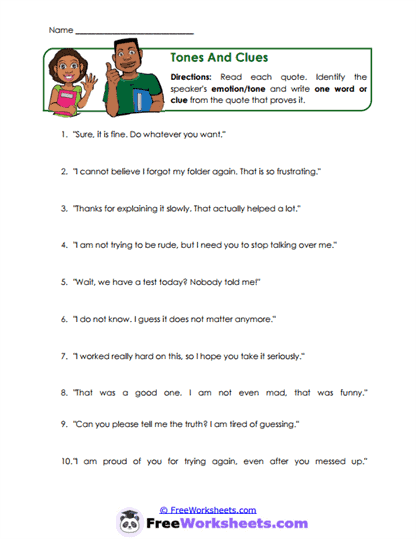
This worksheet is a tone identification activity that helps students recognize emotions in spoken language. It focuses on understanding how word choice reveals feelings and intent. Students read short quotes and determine the speaker’s emotion, then identify a clue from the text that supports their answer. For example, “I cannot believe I forgot again” becomes frustration based on the word “cannot believe.” This builds emotional awareness and interpretation skills.
Curriculum and Grade Alignment
This worksheet is appropriate for grades 5 through 8 and supports social-emotional and reading comprehension skills. The primary goal is to help students identify tone and support their thinking with evidence. Students should already understand basic emotions and descriptive language. It aligns with CCSS.ELA-LITERACY.RL.6.4, which focuses on analyzing word choice and tone. In Texas, it connects to TEKS 110.7(b)(5) related to comprehension and analysis.
Student Tasks
On this worksheet, students will read each quote and identify the speaker’s emotion. They will then write one word or phrase from the quote that supports their answer. Each task requires careful reading and interpretation of tone. Students must connect emotional meaning to specific language clues. The activity strengthens both inference and evidence-based thinking.
Common Challenges and Misconceptions
Students may choose emotions that are too general, such as “happy” instead of more specific feelings like “relieved.” Some might struggle to find exact words that support their answers. Others may rely on personal interpretation instead of text evidence. There can also be confusion when tone is subtle or mixed. Teachers should encourage close reading and discussion of word choices.
Implementation Guidance
Teachers can use this worksheet during lessons on tone, inference, or emotional awareness. It works well as a guided activity where students explain their reasoning aloud. Small group discussions can help students compare interpretations. At home, parents can use it to talk about emotions in everyday language. This activity supports both literacy and social-emotional development.
Details and Features
The worksheet includes clear instructions and ten carefully selected quotes. It provides space for both emotion identification and text evidence. The layout is simple and easy to follow for students. Visual design elements make the worksheet engaging without distraction. It is ideal for classroom, small group, or independent use.