
About This Worksheet
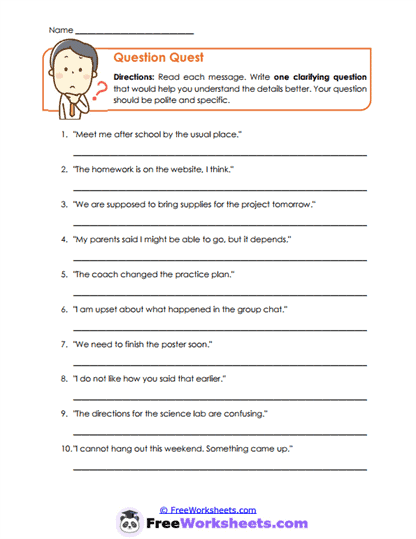
This worksheet is a clarifying question practice activity that helps students improve understanding during conversations. It focuses on active listening by teaching students how to ask polite and specific follow-up questions. Learners read short messages that are unclear or incomplete and create a question to gather more information. For example, “Meet me after school by the usual place” becomes “Can you tell me exactly where we should meet after school?” This strengthens both comprehension and communication skills.
Curriculum and Grade Alignment
This worksheet is designed for grades 4 through 7 and targets listening and speaking skills within social-emotional learning. The main goal is to help students recognize when information is unclear and respond appropriately. Students should already understand basic sentence structure and question formation. It aligns with CCSS.SL.5.1, which emphasizes collaborative discussions and asking questions to clarify understanding. In Texas, it connects to TEKS 110.6(b)(1) related to effective communication and listening.
Student Tasks
On this worksheet, students will read a series of short, unclear messages and write one clarifying question for each. They must ensure their questions are polite and specific. Each response requires students to think about what information is missing. Learners will practice forming complete questions that help improve understanding. The activity encourages thoughtful and respectful communication.
Common Challenges and Misconceptions
Students may ask questions that are too vague, such as “What do you mean?” without adding detail. Some might forget to keep their tone polite and respectful. Others may struggle to identify exactly what information is missing in each message. There can also be confusion between asking a question and making a statement. Teachers should model strong examples and provide sentence starters to support students.
Implementation Guidance
Teachers can use this worksheet during lessons on communication skills or group work expectations. It works well as a warm-up before discussions or collaborative activities. Students can also share their questions in pairs to compare effectiveness. At home, parents can use it to encourage clearer communication during daily conversations. This activity supports both classroom participation and real-world interactions.
Details and Features
The worksheet includes clear directions and ten short messages for students to analyze. It is designed as a one-page printable for easy classroom use. The layout provides space for written responses. Visual elements add engagement without distracting from the task. It is suitable for independent practice or guided instruction.