
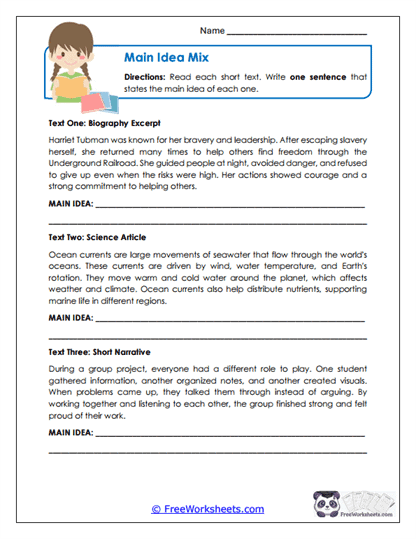
About This Worksheet
This worksheet is a strong follow-up that helps students really refine their understanding of main idea by focusing on what belongs and what doesn’t. A teacher might explain to a parent, “We’re training students to be selective readers-they need to know what supports the main idea and what’s just extra information.” It’s designed for Grade 6 students to read a space-related passage and sort details based on relevance. For example, students learn to ignore interesting but unrelated facts about space travel.
Curriculum and Grade Alignment
This activity aligns with CCSS.ELA-LITERACY.RI.6.2, focusing on identifying central ideas and distinguishing relevant details. A teacher might say, “This is where students start thinking like strong readers-they’re making decisions about importance.” This builds comprehension and analytical skills. It also connects to science content.
Student Tasks
On this worksheet, students will read a passage about space exploration. A teacher might explain, “They’ll identify the main idea and then decide which details support it and which ones don’t.” Students must justify their choices, which strengthens their reasoning. This makes the task more than just sorting-it becomes thinking.
Common Challenges and Misconceptions
Students may think all details in a passage are equally important. A teacher might note, “They’ll keep everything instead of filtering.” Another challenge is recognizing when a detail is related but not essential. Teachers can support students by asking, “Does this detail help explain the main idea?”
Implementation Guidance
In the classroom, this worksheet works really well as a thinking activity in small groups. A teacher might say, “We often have students defend their choices to each other.” At home, parents can support by asking why certain details were included or excluded. That conversation strengthens understanding.
Details and Features
The worksheet includes a high-interest space passage and a clear sorting task. A teacher might point out, “It’s engaging, and it really pushes students to think critically.” The structure supports organized thinking and reasoning. It is easy to print and use in any setting.