
About This Worksheet
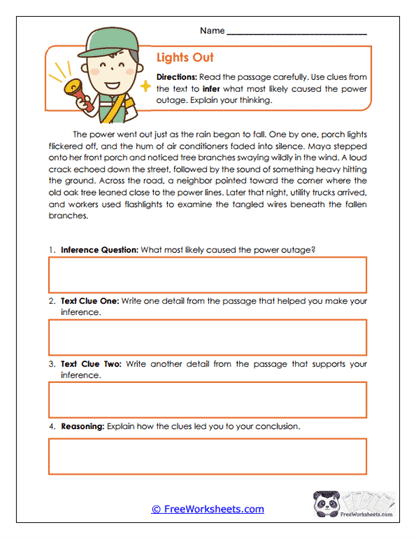
This worksheet is a great way to help students practice making inferences, which is really just a fancy way of saying “figuring things out using clues.” A teacher might explain to a parent, “This is where students start thinking like detectives while they read-they’re not just taking information in, they’re piecing it together.” It’s designed for Grade 6 students to read carefully and use details to draw a logical conclusion. For example, students figure out what caused a power outage based on clues in the text.
Curriculum and Grade Alignment
This activity aligns with CCSS.ELA-LITERACY.RL.6.1, which focuses on citing textual evidence to support inferences. A teacher might say, “We’re helping students understand that good readers don’t guess-they prove their thinking.” This builds strong reasoning and comprehension skills. It also supports problem-solving across subjects.
Student Tasks
On this worksheet, students will read a short passage about a power outage. A teacher might explain, “They’ll answer what most likely caused the outage, but they have to back it up with clues from the text.” Students identify at least two pieces of evidence and explain their reasoning. This helps them connect details to conclusions in a clear way.
Common Challenges and Misconceptions
Students often jump to conclusions without using evidence. A teacher might note, “They’ll guess the answer but won’t explain how they got there.” Another challenge is choosing strong, relevant clues. Teachers can support students by asking, “Which detail helped you the most, and why?”
Implementation Guidance
In the classroom, this worksheet works really well as a guided reading activity. A teacher might say, “We often highlight clues together before students answer.” At home, parents can support by asking their child how they figured out their answer. This encourages deeper thinking and explanation.
Details and Features
The worksheet includes a short, engaging scenario and structured response sections. A teacher might point out, “It walks students through the thinking process step by step.” The layout helps students organize their ideas clearly. It is easy to print and use anywhere.