
About This Worksheet
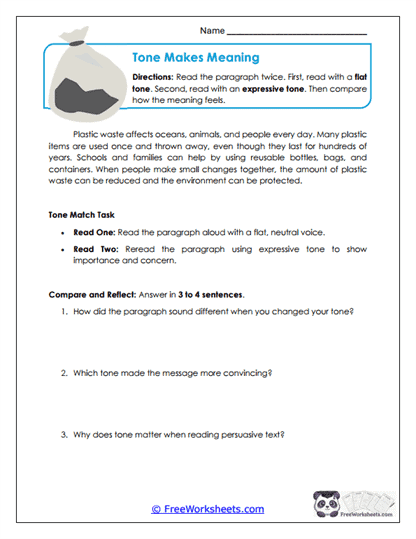
This worksheet really helps students understand something that can be tricky at this age-how tone changes the meaning of what we read. A teacher might explain to a parent, “It’s not just about reading the words correctly, it’s about how those words sound and feel when we say them out loud.” It’s designed for Grade 6 students to experiment with reading the same passage in different ways. For example, reading in a flat voice versus an expressive voice shows how tone can completely shift the message.
Curriculum and Grade Alignment
This activity aligns with CCSS.ELA-LITERACY.RF.6.4, focusing on reading with appropriate expression and understanding how that impacts meaning. A teacher might say, “Students are learning that expression isn’t extra-it’s part of comprehension.” This builds stronger reading fluency and deeper understanding. It also prepares students for presentations and more advanced reading tasks.
Student Tasks
On this worksheet, students will read a short passage about plastic waste twice using different tones. A teacher might explain, “First they read it in a neutral voice, then they read it with expression to show concern or importance.” Students compare how the passage feels each time. They also reflect on which version was more effective and why.
Common Challenges and Misconceptions
Students may not realize how much tone affects understanding. A teacher might note, “They’ll read both versions the same way without noticing the difference.” Another challenge is knowing how to adjust their voice appropriately. Teachers can support students by modeling expressive reading and discussing how it changes meaning.
Implementation Guidance
In the classroom, this worksheet works really well as a whole-group demonstration followed by independent practice. A teacher might say, “We read it together first so students can hear the difference clearly.” At home, parents can support by listening and asking which version sounded more convincing. This helps students connect tone to communication.
Details and Features
The worksheet includes a short, meaningful passage and guided tone practice steps. A teacher might point out, “It’s simple, but it creates those ‘aha’ moments about reading.” The reflection questions encourage deeper thinking. It is easy to print and use in any setting.