
About This Worksheet
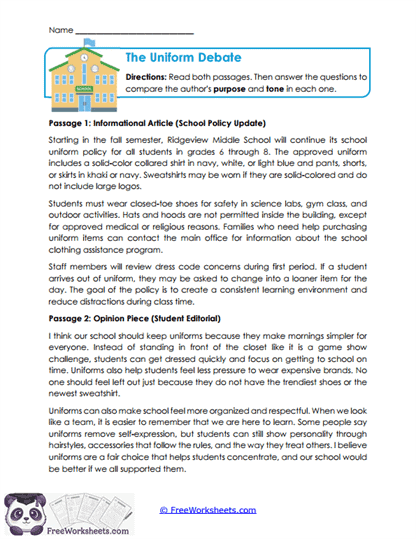
This worksheet helps students compare how purpose and tone differ between informational and opinion texts on the same topic. A teacher might explain to a parent, “This is a powerful one because students see how the same topic can be presented in completely different ways.” It teaches Grade 6 students to analyze how purpose and tone shape meaning. For example, one passage informs about school policy while the other argues in favor of uniforms.
Curriculum and Grade Alignment
This activity aligns with CCSS.ELA-LITERACY.RI.6.6 by focusing on comparing author’s purpose and tone across texts. A teacher might say, “Students are learning to recognize that not all texts are written the same way, even when they share a topic.” This builds strong analytical and comparison skills. It also supports understanding of informational versus persuasive writing.
Student Tasks
On this worksheet, students will read two passages about school uniforms-one informational and one opinion-based. A teacher might explain, “They’ll compare the purpose and tone of each passage and answer questions about how they differ.” Students identify key details that show whether the author is informing or persuading. This helps them understand how writing style influences meaning.
Common Challenges and Misconceptions
Students may struggle to clearly distinguish between informative and persuasive purposes. A teacher might note, “They sometimes think both are just giving information.” Another challenge is identifying tone differences between the passages. Teachers can support students by having them highlight words that signal opinion versus fact.
Implementation Guidance
In the classroom, this worksheet works well as a comparison activity or group discussion. A teacher might say, “We often create a chart together to compare the two passages.” At home, parents can support by asking their child how each passage feels different and why. This encourages deeper thinking about writing styles.
Details and Features
The worksheet includes two clearly contrasting passages and structured comparison questions. A teacher might point out, “It’s very effective because students can directly see the differences side by side.” The format supports both comprehension and analysis. It is easy to print and suitable for classroom or home use.