
About This Worksheet
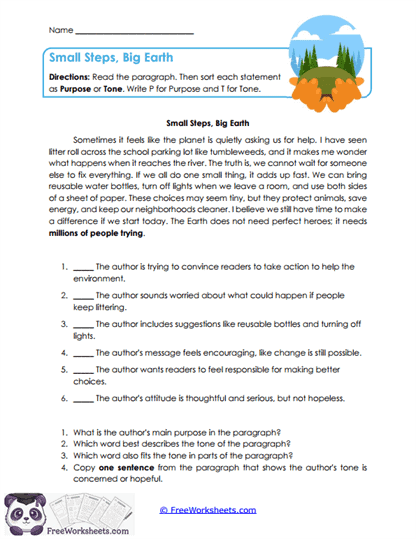
This worksheet helps students understand both an author’s purpose and tone by exploring a message about helping the environment. A teacher might explain to a parent, “This one really shows students how an author can both inform and inspire at the same time.” It teaches Grade 6 students to recognize why the author wrote the passage and how they feel about the topic. For example, suggesting small actions like recycling supports a purpose of encouraging readers to make a difference.
Curriculum and Grade Alignment
This activity aligns with CCSS.ELA-LITERACY.RI.6.6, focusing on identifying an author’s purpose and tone in informational text. A teacher might say, “Students are learning to answer two big questions-why did the author write this, and how do they feel about it?” This builds deeper comprehension and critical thinking. It also connects to real-world topics like environmental responsibility.
Student Tasks
On this worksheet, students will read a short passage about helping the planet through small actions. A teacher might explain, “They’ll sort statements based on whether they describe purpose or tone, which really helps clarify the difference.” Students then answer questions about the author’s main purpose and tone. They also find text evidence to support their answers.
Common Challenges and Misconceptions
Students often mix up purpose and tone, thinking they are the same thing. A teacher might note, “They’ll say the purpose is ‘hopeful’ instead of recognizing that’s actually tone.” Another challenge is choosing evidence that clearly supports tone. Teachers can support students by modeling how to separate what the author is trying to do from how they sound.
Implementation Guidance
In the classroom, this worksheet works well as a guided activity where the teacher models one example first. A teacher might say, “We go through one statement together and decide if it’s purpose or tone before they try the rest.” At home, parents can support by asking their child what the author wants readers to do and how the message feels. This builds strong reading habits.
Details and Features
The worksheet includes a short, engaging passage and a mix of sorting and comprehension questions. A teacher might point out, “It’s interactive, which keeps students thinking the whole time.” The structure supports step-by-step understanding of purpose and tone. It is easy to print and use in any setting.