
About This Worksheet
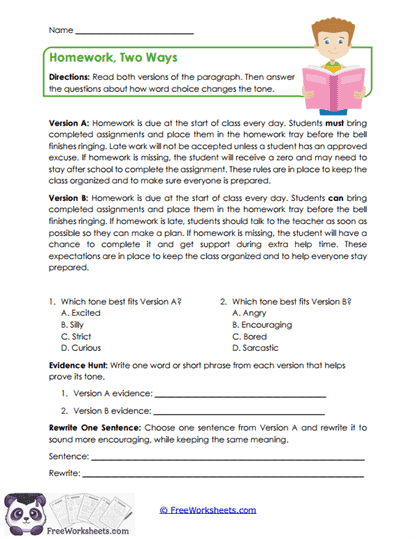
This worksheet is a fantastic way to help students see how tone can completely change the way a message feels, even when the topic stays the same. A teacher might explain to a parent, “Both paragraphs are about homework rules, but one feels strict and the other feels supportive-and that’s exactly what we want students to notice.” It teaches Grade 6 students that authors make intentional word choices to shape how readers react. For example, “must” and “no exceptions” create a strict tone, while “you have a choice” creates a more encouraging one.
Curriculum and Grade Alignment
This activity aligns with CCSS.ELA-LITERACY.RI.6.6, focusing on analyzing how tone reveals an author’s purpose and perspective. A teacher might say, “Students are learning that it’s not just what the author says, but how they say it that matters.” This builds strong comprehension and prepares students for both analyzing and writing persuasive texts. It also supports understanding how language influences reader response.
Student Tasks
On this worksheet, students will read two versions of a paragraph about homework expectations. A teacher might explain, “They’ll decide what tone each version has and then find evidence that proves it.” Students identify tone words like strict or encouraging and support their choices with specific phrases. They also rewrite a sentence to change the tone, which really deepens their understanding.
Common Challenges and Misconceptions
Students may recognize tone differences but struggle to explain why those differences exist. A teacher might note, “They’ll say one sounds nicer, but not point to the exact words that create that feeling.” Another challenge is rewriting sentences without fully shifting the tone. Teachers can support students by modeling how word choice changes meaning.
Implementation Guidance
In the classroom, this worksheet works well as a side-by-side comparison activity. A teacher might say, “We read both versions aloud so students can actually hear the tone difference.” At home, parents can support by asking their child how different wording can change how a message feels. This helps students apply the concept beyond the worksheet.
Details and Features
The worksheet includes two clearly written versions of the same idea, making comparison straightforward and effective. A teacher might point out, “It’s a simple setup, but it leads to really strong thinking.” The rewrite task adds an extra layer of skill-building. It is easy to print and works well for both guided and independent practice.