
About This Worksheet
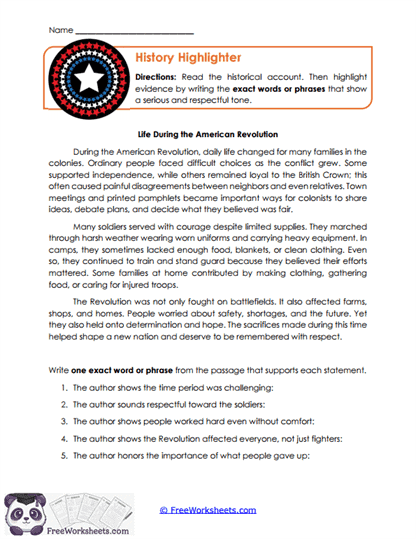
This worksheet helps students explore how tone reflects an author’s purpose in a historical text. A teacher might explain to a parent, “We want students to see how an author can sound respectful or serious when writing about important events.” It teaches Grade 6 students to identify tone through exact words and phrases. For example, describing sacrifices during a war supports a respectful and serious tone.
Curriculum and Grade Alignment
This activity aligns with CCSS.ELA-LITERACY.RI.6.6 by focusing on how tone conveys an author’s perspective and purpose. A teacher might say, “Students are learning that tone isn’t just how something sounds-it shows how the author feels about the topic.” This is especially important when reading historical texts. It builds both comprehension and analytical thinking.
Student Tasks
On this worksheet, students will read a historical account about the American Revolution. A teacher might explain, “They’ll highlight exact words or phrases that show a serious and respectful tone.” Students then match those phrases to statements about the author’s message. This helps them connect language directly to meaning.
Common Challenges and Misconceptions
Students may choose phrases that are important but don’t clearly show tone. A teacher might note, “They sometimes highlight facts instead of words that show feeling or attitude.” Another challenge is explaining why a phrase reflects tone. Teachers can support students by asking them what feeling the words create.
Implementation Guidance
In the classroom, this worksheet works well as part of a social studies integration lesson. A teacher might say, “We talk about how history should be told with respect before reading.” At home, parents can support by discussing how certain topics deserve a serious tone. This helps students connect tone to real-world communication.
Details and Features
The worksheet includes a rich historical passage and a focused highlighting task. A teacher might point out, “It encourages close reading and careful thinking.” The format is clear and easy for students to follow. It works well for both independent and guided instruction.