
About This Worksheet
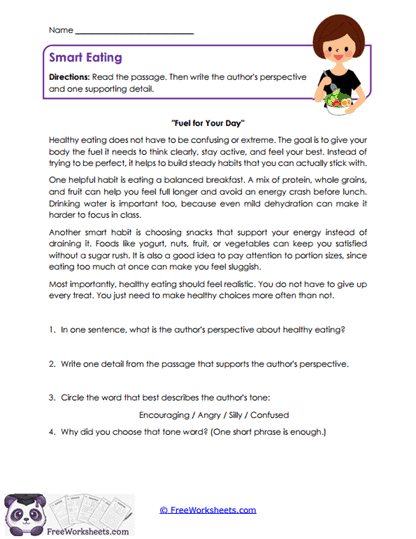
This worksheet is all about helping students understand an author’s perspective, especially in informational text about everyday topics like healthy eating. A teacher might explain to a parent, “We’re teaching students not just to read facts, but to figure out what the author believes and how they communicate that belief.” It helps Grade 6 students recognize that authors often have a message or opinion, even in texts that sound factual. For example, general advice like “eat balanced meals” becomes an author’s perspective that healthy eating should be simple and realistic.
Curriculum and Grade Alignment
In sixth grade, students begin analyzing how authors present ideas and support their viewpoints. This worksheet aligns with CCSS.ELA-LITERACY.RI.6.6, which focuses on determining an author’s point of view or purpose and how it is conveyed. A teacher might say, “Before this, students could find main ideas, but now we’re asking them to explain what the author believes and how they show it.” This is a critical step toward stronger critical reading and writing skills.
Student Tasks
On this worksheet, students will read a short informational passage about healthy eating habits. A teacher might explain, “They’ll identify the author’s perspective in one clear sentence, then find a detail that proves it.” Students also analyze tone by choosing a word that best describes how the author sounds, such as encouraging or serious. Finally, they explain their reasoning, which helps them connect evidence to interpretation.
Common Challenges and Misconceptions
Students often confuse the main idea with the author’s perspective, which can lead to incomplete answers. A teacher might share, “They might say ‘the passage is about food’ instead of recognizing the author’s opinion about making healthy choices.” Another challenge is selecting tone words without truly understanding the author’s voice. To support this, teachers can encourage students to look for clue words that show feeling or attitude.
Implementation Guidance
In the classroom, this worksheet works well as a guided practice activity where the teacher models one question first. A teacher might say, “We read the passage together, then I show them how I find the author’s opinion before they try it themselves.” At home, parents can support by asking their child what the author is trying to convince them of and why. This kind of conversation helps students move beyond surface-level reading.
Details and Features
The worksheet includes a clear, engaging passage and a focused set of questions that build from simple to more analytical thinking. A teacher might point out, “It’s short enough to keep students engaged, but rich enough to practice real skills.” The tone question adds an extra layer of thinking that strengthens comprehension. It is easy to print and works well for both classroom and home use.