
About This Worksheet
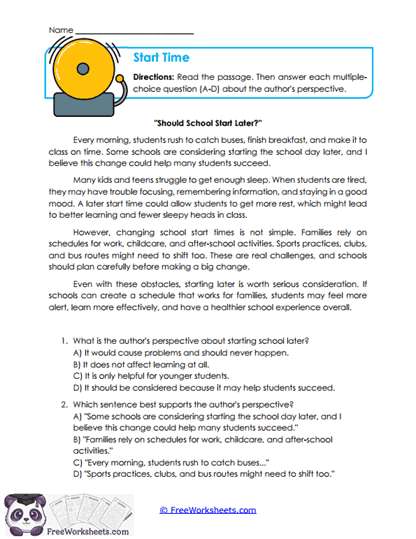
This worksheet helps students understand how an author’s perspective is developed around a real-world issue like school start times. A teacher might explain to a parent, “This one is really powerful because students are reading something that actually connects to their daily lives.” It teaches Grade 6 students to recognize how authors use reasons and evidence to support an opinion. For example, explaining tired students becomes a perspective that schools should start later.
Curriculum and Grade Alignment
This activity aligns with CCSS.ELA-LITERACY.RI.6.6, focusing on identifying and explaining an author’s point of view. A teacher might say, “Students are moving beyond just understanding the topic-they’re learning to explain what the author believes and why.” This skill is essential for critical thinking and evaluating arguments. It also supports future work in persuasive and argumentative writing.
Student Tasks
On this worksheet, students will read an article about the debate over school start times. A teacher might explain, “They’ll identify the author’s perspective and find details that support that opinion.” Students answer questions that require them to connect evidence directly to the author’s claim. They also think about how the author tries to convince the reader.
Common Challenges and Misconceptions
Students may confuse the topic with the author’s actual perspective. A teacher might note, “They’ll say it’s about school schedules instead of recognizing the author’s opinion about changing them.” Another challenge is selecting supporting details that truly match the perspective. Teachers can support students by having them restate the author’s belief before choosing evidence.
Implementation Guidance
In the classroom, this worksheet works well as part of a discussion on real-world issues. A teacher might say, “We often talk about our own opinions first, then compare them to the author’s.” At home, parents can support by asking their child whether they agree with the author and why. This helps students practice backing up their thinking with evidence.
Details and Features
The worksheet includes a relevant, high-interest passage that students can easily connect to. A teacher might point out, “That connection helps them stay engaged and think more deeply.” The questions are structured to guide students from basic understanding to deeper analysis. It is easy to print and works well for both classroom and home use.