
About This Worksheet
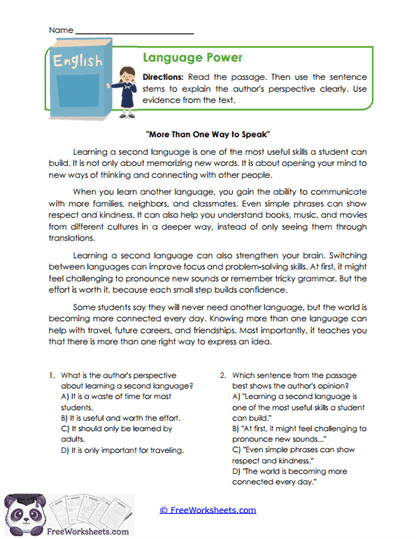
This worksheet is all about helping students understand how an author’s perspective is shaped through ideas and explanations about learning a new language. A teacher might explain to a parent, “This one really helps students see that an author’s belief isn’t just stated-it’s built through reasons and examples.” It’s designed for Grade 6 students to recognize how authors support their viewpoints in informational text. For example, saying language learning builds connections becomes the perspective that learning another language is valuable and worthwhile.
Curriculum and Grade Alignment
This activity aligns with CCSS.ELA-LITERACY.RI.6.6 by focusing on identifying an author’s perspective and how it is supported. A teacher might say, “Students are now expected not just to find the opinion, but to explain how the author proves it.” This builds a strong foundation for both reading comprehension and persuasive writing. It also connects to real-world learning and global awareness topics.
Student Tasks
On this worksheet, students will read a passage about the benefits of learning more than one language. A teacher might explain, “They’ll identify the author’s perspective and then choose the sentence that best supports it.” Students must look closely at the text to decide which evidence is strongest. This helps them practice connecting ideas and supporting details in a meaningful way.
Common Challenges and Misconceptions
Students may choose supporting details that are interesting but not directly tied to the author’s main perspective. A teacher might note, “They sometimes pick a sentence they like instead of the one that best proves the point.” Another challenge is understanding that perspective is broader than just one sentence. Teachers can support students by encouraging them to restate the author’s belief before choosing evidence.
Implementation Guidance
In the classroom, this worksheet works well as a focused reading activity with discussion built in. A teacher might say, “We often pause after reading to ask, ‘What does the author want us to believe?’ before moving to the questions.” At home, parents can support by asking their child to explain why learning another language might be important. This helps students connect the text to real-life thinking.
Details and Features
The worksheet includes a clear, engaging passage and targeted multiple-choice questions. A teacher might point out, “It’s simple in structure but really pushes students to think carefully.” The topic is meaningful and relatable for students thinking about their future. It is easy to print and use in both classroom and home settings.