
About This Worksheet
This worksheet helps students dig into an author’s perspective by focusing on how thoughts and feelings are revealed in a personal narrative. A teacher might explain to a parent, “We want students to notice how an author shows their feelings through small details, not just direct statements.” It teaches Grade 6 students to look closely at word choice and internal reactions to understand perspective. For example, a simple action like hesitating can reveal uncertainty or nervousness.
Curriculum and Grade Alignment
In sixth grade, students are expected to analyze how authors convey perspective through narration and description. This worksheet supports CCSS.ELA-LITERACY.RI.6.6 and also connects to narrative analysis skills. A teacher might say, “Students already understand what happens in a story, but now we’re asking them to explain how the author feels about those events.” This builds deeper comprehension and prepares students for more advanced analysis.
Student Tasks
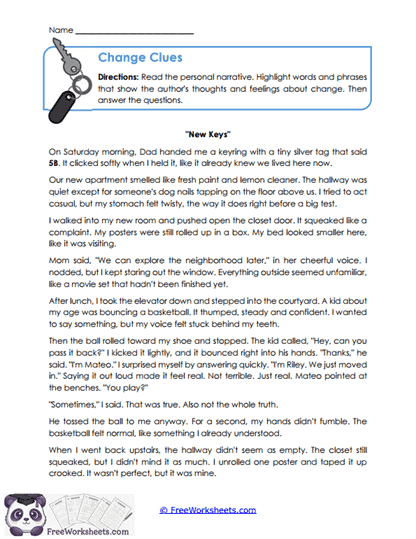
On this worksheet, students will read a personal narrative about moving to a new place and adjusting to change. A teacher might explain, “They’ll highlight specific words and phrases that show how the narrator feels throughout the story.” Students then answer questions that connect those clues to the author’s perspective. They are guided to think about how feelings shift from beginning to end.
Common Challenges and Misconceptions
Students often focus only on obvious emotions and miss subtle clues in the text. A teacher might share, “They’ll pick out words like ‘happy’ or ‘sad’ but overlook actions that show deeper feelings.” Another challenge is connecting multiple clues into a clear explanation of perspective. Teachers can support students by modeling how to combine evidence into one strong idea.
Implementation Guidance
In the classroom, this worksheet works well as a close reading activity where students annotate the text. A teacher might say, “We go through the first paragraph together and highlight clues before they try the rest independently.” At home, parents can help by asking their child how the narrator feels and what words show that. This turns reading into a thoughtful conversation rather than just answering questions.
Details and Features
The worksheet includes a relatable narrative and built-in highlighting directions to guide student thinking. A teacher might point out, “It encourages active reading instead of passive reading.” The questions are designed to move from simple identification to deeper explanation. It is easy to print and works well for both independent and guided instruction.