
About This Worksheet
This worksheet is a great step into understanding author’s purpose and tone, which can be tricky but so important. I’d explain to another teacher that this is where students begin to notice not just what the author says, but how they feel about it. The topic of urban wildlife is interesting and a little surprising, which helps students stay curious as they read.
Curriculum and Grade Alignment
This activity supports Grade 6 skills in identifying author’s purpose, perspective, and tone. The goal is for students to determine why the text was written and how the author’s viewpoint shapes the message. It aligns with Common Core Standard RI.6.6 and supports TEKS 6.9(F), analyzing author’s purpose and perspective.
Student Tasks
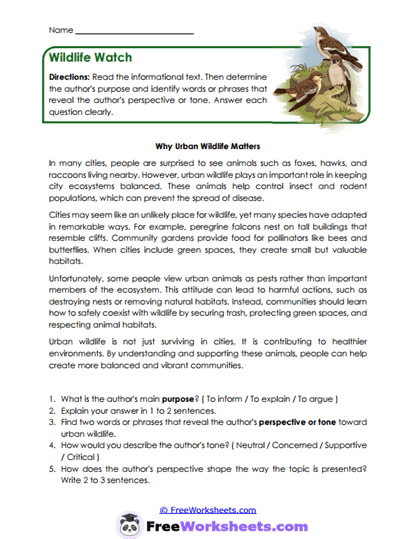
Students read an informational text about urban wildlife. Then they identify the author’s purpose (to inform, explain, or argue), find words that reveal the author’s perspective, and describe the tone. Finally, they explain how the author’s perspective shapes the text.
Common Challenges and Misconceptions
Students often confuse tone with mood or just guess without evidence. Some may pick a purpose without really thinking it through. Others may struggle to explain how perspective affects the writing. I usually prompt them with, “What clues is the author giving you?”
Implementation Guidance
This worksheet works well as a guided reading activity. I’d model identifying one word or phrase that shows the author’s tone and explain it. It’s also great for partner discussions where students compare answers. At home, parents can ask, “What does the author think about this topic?”
Details and Features
The worksheet includes an engaging informational passage. It provides structured practice identifying purpose, tone, and perspective. The questions guide deeper thinking and explanation. It builds strong analytical reading skills.