
About This Worksheet
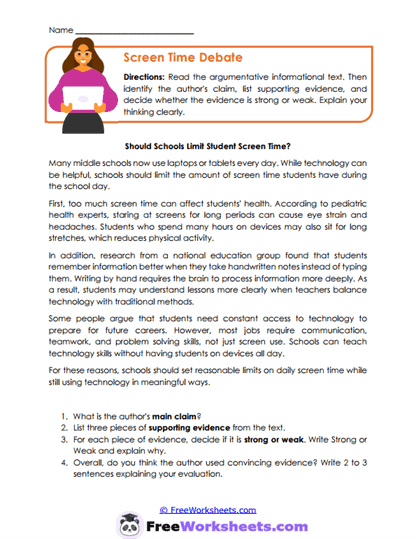
This is one of those worksheets where students really start thinking like critics, not just readers. Instead of just understanding the text, they’re being asked, “Do you actually believe this argument-and why?” I’d tell another teacher this is a great bridge between reading and real-world thinking. The topic of screen time is something every student has an opinion about, so you’ll usually get strong engagement right away.
Curriculum and Grade Alignment
This worksheet supports Grade 6 skills in analyzing arguments and evaluating evidence. The goal is for students to identify the author’s claim, examine supporting evidence, and judge whether that evidence is strong or weak. It aligns with Common Core Standard RI.6.8 and supports TEKS 6.9(E), focusing on evaluating how arguments are supported.
Student Tasks
Students read an argumentative informational text about limiting screen time in schools. Then they identify the author’s main claim and list the supporting evidence. After that, they evaluate whether the evidence is strong or weak and explain their thinking in writing. This pushes them beyond “finding answers” into actually defending their reasoning.
Common Challenges and Misconceptions
Students may assume all evidence is strong just because it supports the claim. Some may give very short answers like “it’s strong” without explaining why. Others might rely on their personal opinion instead of the text. I usually remind them, “Point to the proof-what makes this convincing?”
Implementation Guidance
This works really well as a discussion-based lesson. I’d stop after the first piece of evidence and model how to evaluate it out loud. It’s also great for small groups where students can debate whether the evidence is convincing. At home, parents can ask, “Did the author really prove their point?”
Details and Features
The worksheet includes a high-interest argumentative passage. It provides structured steps for identifying claims and evaluating evidence. The questions encourage deeper explanation. It builds strong reasoning and analysis skills.