
About This Worksheet
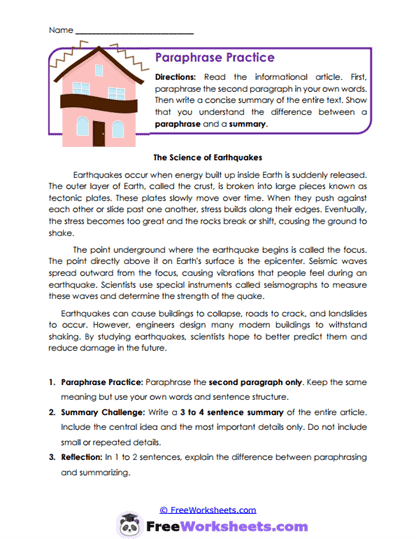
This is one of those foundational skills that really pays off later-learning how to say the same idea in your own words. I’d tell another teacher this is where students move beyond copying and start truly understanding what they read. It’s also a great checkpoint to see if students actually grasp the text. The structure here makes it very clear and manageable, which is helpful for building confidence.
Curriculum and Grade Alignment
This activity supports Grade 6 skills in paraphrasing and summarizing informational text. The goal is for students to restate ideas accurately and write concise summaries. It aligns with Common Core Standard RI.6.2 and W.6.2, and supports TEKS 6.6(C), summarizing texts and maintaining meaning.
Student Tasks
Students read an informational article about earthquakes. First, they paraphrase a paragraph using their own words. Then they write a short summary of the entire text. Finally, they reflect on the difference between paraphrasing and summarizing. This helps them clearly separate these two important skills.
Common Challenges and Misconceptions
Students often copy too closely from the text when paraphrasing. Some may confuse paraphrasing with summarizing. Others might leave out key ideas or change the meaning. I usually remind them, “Keep the meaning, but change the wording.”
Implementation Guidance
This works really well as a modeled lesson. I’d rewrite one sentence together as a class before students try it. It’s also helpful for partner work where students compare paraphrases. At home, parents can ask their child to explain a paragraph in their own words.
Details and Features
The worksheet includes a clear informational passage. It provides structured steps for paraphrasing and summarizing. The reflection piece deepens understanding. It builds strong comprehension and writing skills.