
About This Worksheet
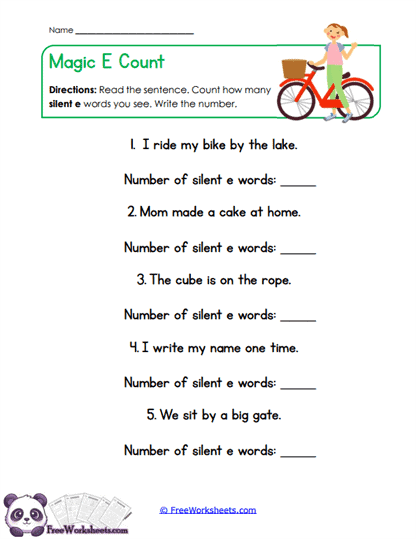
This worksheet helps first grade students identify and count silent e words inside complete sentences. Silent e counting activities teach children how phonics patterns appear in connected reading instead of only single-word practice. Students read sentences and count how many silent e words they can find. For example, in the sentence “I ride my bike by the lake,” students identify several silent e words. This activity supports phonics development, reading fluency, and word-recognition skills.
Curriculum and Grade Alignment
This grade 1 language arts worksheet focuses on phonics, decoding, and reading comprehension. Students practice recognizing silent e spelling patterns within meaningful sentences. Before beginning this activity, learners should understand long vowel sounds and basic sentence-reading skills. Future literacy learning may include reading longer passages with more advanced phonics patterns. This worksheet aligns with CCSS.ELA-LITERACY.RF.1.3.C and TEKS standards related to phonics and word analysis.
Student Tasks
On this worksheet, students will read several complete sentences containing silent e words. Learners identify the silent e words in each sentence and count how many appear. Children write the total number on the line provided below each sentence. Students strengthen decoding and phonics skills while practicing careful sentence reading and word analysis. The activity also encourages close attention to spelling patterns during reading instruction.
Common Challenges and Misconceptions
Some first grade students may count words that end in e but do not follow the silent e pattern correctly. Children can also overlook silent e words if they rush through the sentence too quickly. A few learners may lose track while counting multiple silent e words in one sentence. Others may need support distinguishing between short vowel and long vowel patterns. Teachers can help by modeling how to underline silent e words before counting them.
Implementation Guidance
Teachers can use this worksheet during phonics instruction, guided reading, or literacy center practice. Parents may also use the activity at home while reading sentences aloud together. Encouraging children to highlight or point to silent e words can strengthen phonics awareness and fluency. Adults can ask questions like “Which words have a silent e at the end?” to guide learning. This worksheet also works well for intervention support or independent phonics review.
Details and Features
The worksheet combines sentence reading with phonics analysis to strengthen real-world reading skills. Familiar silent e vocabulary keeps first grade learners engaged and confident during practice. Simple counting tasks provide structured phonics review without overwhelming young readers. Clear sentence spacing supports independent reading and visual tracking. The worksheet prints clearly for classroom instruction, homeschool use, or intervention support.