
About This Worksheet
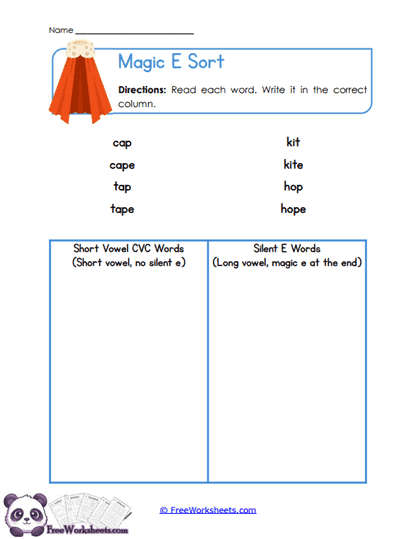
This worksheet helps first grade students recognize the difference between short vowel CVC words and silent e words. Silent e activities teach children how adding an e at the end of a word can change the vowel sound from short to long. Students sort words like cap and cape into the correct columns based on the vowel pattern. For example, cap has a short vowel sound, while cape has a long vowel sound because of the silent e. This activity supports phonics development, decoding skills, and reading fluency.
Curriculum and Grade Alignment
This grade 1 language arts worksheet focuses on phonics, spelling patterns, and long vowel recognition. Students practice identifying short vowel CVC words and silent e words with long vowel sounds. Before beginning this activity, learners should understand basic short vowel sounds and simple CVC word patterns. Future literacy learning may include reading more advanced long-vowel word families and multisyllable words. This worksheet aligns with CCSS.ELA-LITERACY.RF.1.3.C and TEKS standards related to phonics and word analysis.
Student Tasks
On this worksheet, students will read a list of words containing both short vowel and silent e patterns. Learners sort the words into the correct column labeled Short Vowel CVC Words or Silent E Words. Children carefully listen for vowel sounds while comparing word endings. Students strengthen decoding and spelling skills while learning how silent e changes pronunciation. The activity also encourages close reading and word-pattern recognition during phonics instruction.
Common Challenges and Misconceptions
Some first grade students may focus only on whether a word ends with e instead of listening to the vowel sound carefully. Children can also confuse pairs like hop and hope because the spelling looks very similar. A few learners may forget that silent e changes the vowel from short to long. Others may rush through the sorting without rereading the words aloud. Teachers can help by modeling how to stretch the vowel sounds while comparing word pairs together.
Implementation Guidance
Teachers can use this worksheet during phonics instruction, literacy centers, or small-group reading lessons. Parents may also use the activity at home while practicing word reading and spelling patterns together. Encouraging children to say the words aloud can strengthen sound recognition and reading confidence. Adults can ask questions like “Does the vowel say its name?” to support understanding. This worksheet also works well for intervention review or independent phonics practice.
Details and Features
The worksheet includes familiar word pairs that clearly demonstrate the difference between short vowels and silent e patterns. Sorting activities help first grade learners organize and compare spelling patterns visually. Large writing spaces support neat handwriting and independent participation. The simple two-column format keeps the activity clear and manageable for young readers. The worksheet prints clearly for classroom instruction, homeschool learning, or intervention support.