
About This Worksheet
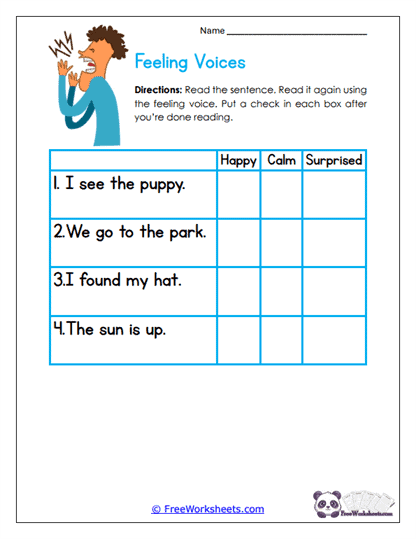
As students grow as readers, they begin to understand that reading is not just about saying words-it’s about how those words sound. This Kindergarten worksheet helps children explore reading with expression by using different “feeling voices.” When students change their tone, they start to understand how emotion brings meaning to a sentence. For example, I see the puppy can sound excited, calm, or even surprised depending on how it is read aloud.
Curriculum and Grade Alignment
This worksheet is a great fit for Kindergarten students who are ready to move beyond basic word reading into expressive fluency. The goal is to help learners connect voice, tone, and meaning while reading simple sentences. Students should already be able to read basic sentences independently. It aligns with Common Core Standards RF.K.1 and RF.K.4 and supports TEKS ELAR K.2.B for fluency and expressive reading.
Student Tasks
Students will read each sentence several times using different feeling voices, such as happy, calm, or surprised. After reading, they will check a box to show they completed each version. This encourages them to think about how their voice changes the way a sentence sounds. It also helps build confidence with oral reading.
Common Challenges and Misconceptions
Some students may read each sentence the same way without changing their tone. Others might not fully understand how to match a feeling to a voice. A few learners may feel shy or unsure about reading expressively. Teachers can support students by modeling each feeling clearly and encouraging playful practice.
Implementation Guidance
This worksheet works especially well during group reading or fluency centers. Teachers can demonstrate each voice and have students repeat together before trying on their own. At home, parents can turn it into a fun activity by acting out the voices. The more relaxed and playful it feels, the more students will engage.
Details and Features
The worksheet includes simple sentences paired with emotion-based reading tasks. The structure is clear and encourages repeated practice. It helps students move from flat reading to expressive reading. The printable layout makes it easy to use in both classroom and home settings.