
About This Worksheet
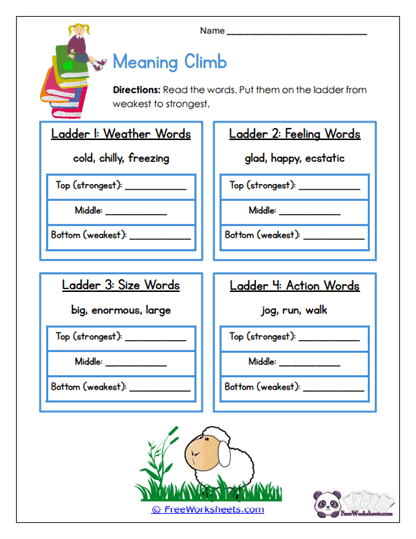
This worksheet helps first grade students understand shades of meaning by organizing words from weakest to strongest. Shades of meaning activities teach children that words can have similar meanings but different levels of strength or intensity. Students sort groups of related words like cold, chilly, and freezing into the correct order on a ladder. For example, chilly feels weaker than freezing because freezing describes a much colder temperature. This activity supports vocabulary growth, reading comprehension, and stronger word understanding.
Curriculum and Grade Alignment
This grade 1 language arts worksheet focuses on vocabulary development, word relationships, and shades of meaning. Students practice comparing related words and deciding which word has the strongest or weakest meaning. Before beginning this activity, learners should understand basic descriptive vocabulary and simple word meanings. Future literacy learning may include using precise vocabulary in speaking and writing. This worksheet aligns with CCSS.ELA-LITERACY.L.1.5.D and TEKS standards related to word meaning and vocabulary acquisition.
Student Tasks
On this worksheet, students will read groups of related words connected to weather, feelings, size, and actions. Learners place the words onto ladders from weakest meaning at the bottom to strongest meaning at the top. Children think carefully about how each word changes in strength or intensity. Students strengthen vocabulary and critical-thinking skills while comparing word meanings. The activity also encourages discussion about descriptive language and word choice.
Common Challenges and Misconceptions
Some first grade students may think all similar words mean exactly the same thing. Children can also struggle with understanding subtle differences between words like happy and ecstatic. A few learners may rely only on word familiarity instead of thinking about meaning strength carefully. Others may confuse physical size with emotional intensity during sorting activities. Teachers can help by acting out or discussing the words together before students complete the worksheet independently.
Implementation Guidance
Teachers can use this worksheet during vocabulary lessons, small-group instruction, or literacy centers. Parents may also use the activity at home while talking about describing words in everyday conversations. Encouraging children to explain why one word feels stronger than another can deepen understanding and language development. Adults can ask questions like “Which word sounds the biggest or strongest?” to guide thinking. This worksheet also works well for intervention support or independent vocabulary review.
Details and Features
The worksheet includes multiple themed ladders that keep first grade learners engaged while practicing vocabulary skills. Organized boxes and ladder visuals help students clearly see the progression from weak to strong meanings. Familiar word groups make the activity approachable while still encouraging deeper thinking. Large writing spaces support neat handwriting and independent completion. The worksheet prints clearly for classroom instruction, homeschool learning, or intervention support.